

LANZA Atelier: Redefining Architecture Through Experience
LANZA Atelier, the Mexico City- based practice founded by Isabel Abascal and Alessandro Arienzo in 2015, has spent the past decade exploring how architecture can shape the ordinary experience of being in the world. Their work reaches across architecture, furniture, exhibition design, and public projects, with particular attention to familiar materials, craft, context, and the ways people actually inhabit space. The studio has earned international recognition, including the Architectural League of New York’s Emerging Voices Award in 2023, while its work has been exhibited at institutions including SFMOMA, where it was the subject of a solo exhibition in 2018.
That approach has now brought LANZA to one of architecture’s most visible stages: the 2026 Serpentine Pavilion in London. For a serpentine, Abascal and Arienzo transformed the familiar crinkle-crankle wall into a permeable structure that shapes movement without simply restricting it. Built from brick, the pavilion creates spaces for gathering while remaining in conversation with the surrounding landscape.
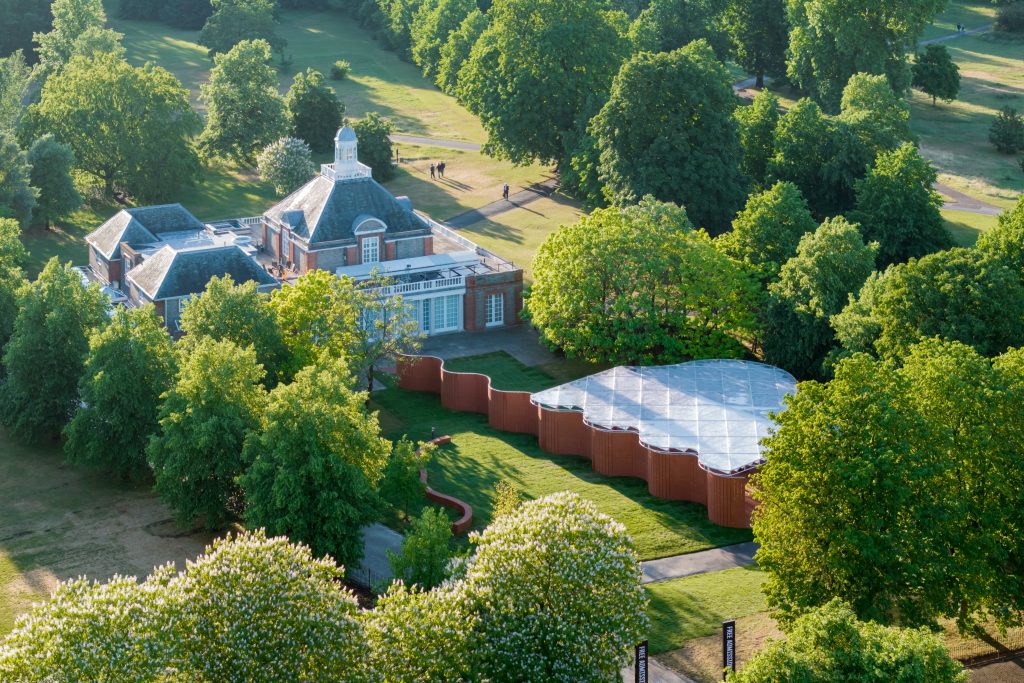
It’s a fitting project for a practice interested in architecture as something experienced rather than simply looked at. As Abascal and Arienzo put it, “Architecture is something we experience from the moment we are born.” Their work asks us to consider what happens when we pay closer attention to those experiences: the materials beneath our feet, the sounds around us, the spaces that bring us together, and the layers of history embedded in the places we inhabit.
We spoke with LANZA Atelier about architecture as a force that shapes how we move through the world, the sensory qualities that often disappear when architecture is reduced to an image, and the particular influence of Mexico City on their practice. The duo also talked about the Serpentine Pavilion, the architecture they find most emblematic of their city, and what they hope to explore in the next decade of LANZA.
You’re now a little over ten years into LANZA Atelier. How has your practice changed the way you think about architecture’s ability to shape how we see and experience the world?
Architecture can feel like a very niche discipline that only interests those involved in it. Through working on various public projects that are visited by many different people from different backgrounds, we have realized that architecture is actually something that touches everyone. During these ten years, we also welcomed two sons, and that experience has provoked many reflections. We have discussed how architecture is something we experience from the moment we are born. Architecture renders our arrival into the world, and we all inhabit spaces, so architecture has a great responsibility to shape our passage through the world positively.

What is the most underrated element of architecture? Is there something that can completely change how a space feels but rarely gets enough attention?
In our very visual culture, atmospheric qualities that inform architecture, like sound, smell, or tactile experiences, are usually missing from the screen and from the way we consume architecture. We were interested, for example, in having a ceramic floor at the Serpentine Pavilion because we thought the clay pavers added to the visitors’ sensory experience just as much as the walls themselves.
Mexico City has an extraordinary architectural history, but it also has a very particular way of layering the old, the new, the formal, and the improvised. How does living and working there shape the way you practice?
Mexico City has fantastic weather, never too cold, never too warm, so the outside and the inside are very connected. It is a partially informal city, so many activities take place in the street, and the public realm becomes a very inspiring and performative space. The city is created by many layers of culture that expand through time.
If you had to choose one piece of architecture that captures something essential about the spirit of Mexico City, what would it be, and what does it reveal about the city?
It is quite interesting, for example, how the Templo Mayor was built and rebuilt by the Mexicas as many as seven times, putting one layer on top of the previous one. We see this process as a helicoid, a spiral that moves through time and space.
This same idea of the helicoid is present in our design process, in which we come back to the same point time after time, but we are never at the same exact place; we have moved upwards or downwards, so we can have a different perspective. This becomes quite obvious when one visits an archaeological site at one moment in life and then, a decade later, comes back and experiences the same place with such a different sensitivity. Mexico City has this same capacity to accumulate layers while constantly being transformed.
When you think about the next ten years of LANZA, what do you want to explore that you haven’t had the opportunity to explore yet?
We are interested in continuing to work as we do, perhaps scaling up and having the opportunity to work in new contexts, with new programmes and challenges we haven’t confronted yet. We would like to work with collective housing, for example, while also keeping our connection to cultural institutions and art. We love working within museums and on public projects that anybody has the chance to visit.
Footnotes: The Serpentine Pavilion
Since 2000, the Serpentine Pavilion has turned Kensington Gardens into one of architecture’s most anticipated summer stages. Each year, the Serpentine Galleries commission an architect who has never completed a permanent structure in the UK to create a temporary pavilion, part gathering place, part café, part cultural venue, and, perhaps most importantly, a space for experimentation.
Over its 25-year history, the commission has become a kind of architectural who’s who, beginning with Zaha Hadid’s inaugural pavilion in 2000. Frank Gehry, Rem Koolhaas, Oscar Niemeyer, Toyo Ito, and SANAA are among the Pritzker Prize-winning architects who have since taken over the gardens, while collaborations have expanded the pavilion’s possibilities beyond architecture alone. Herzog & de Meuron and Ai Weiwei joined forces for the 2012 pavilion; artist Theaster Gates brought his own perspective to the commission in 2022.
In recent years, the Serpentine has also made room for a broader generation of international voices, from Bjarke Ingels and Diébédo Francis Kéré to Frida Escobedo, Lina Ghotmeh, Minsuk Cho, and Marina Tabassum. The result is a living archive of contemporary architecture, one temporary structure at a time.