
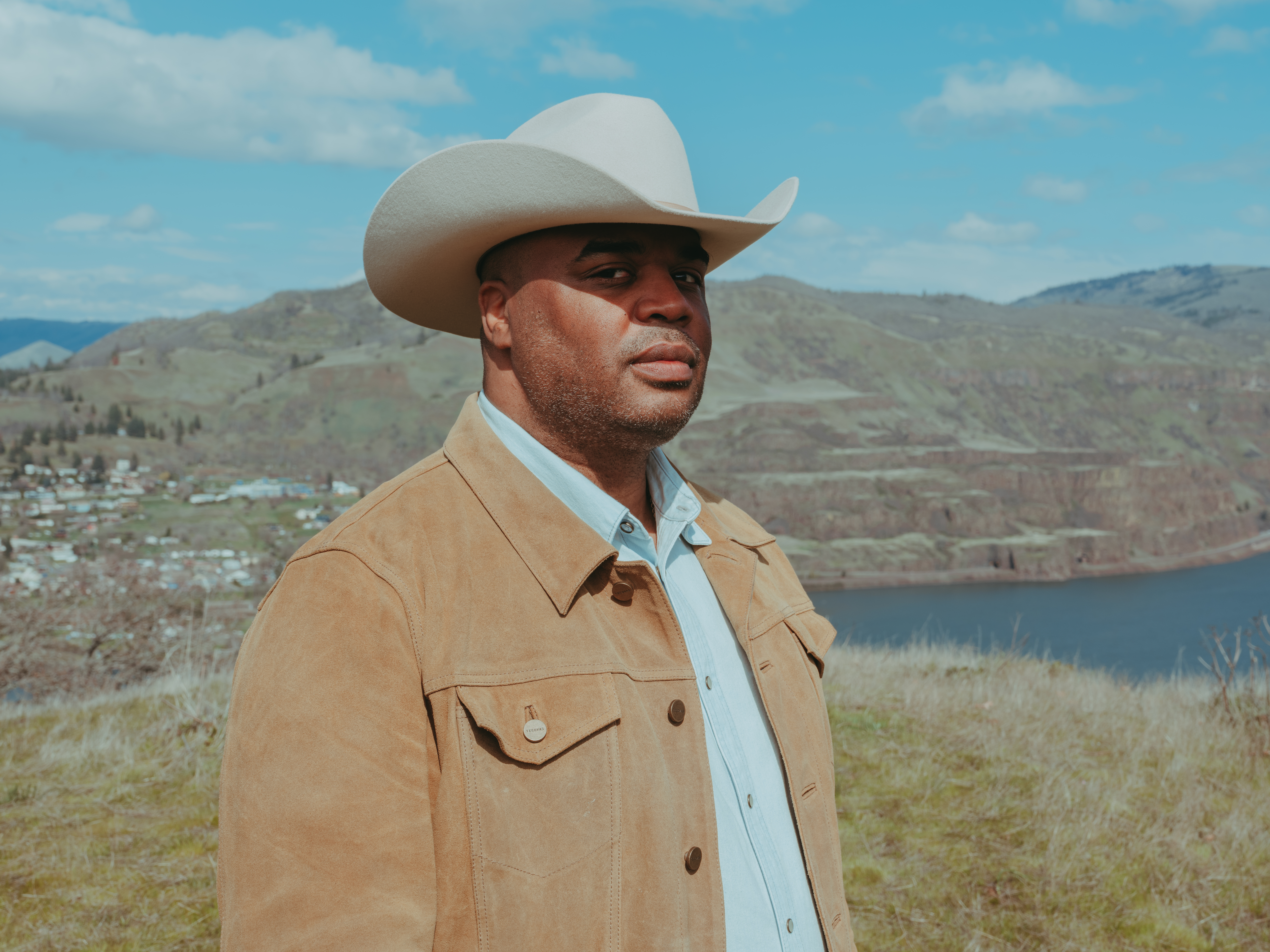
Eight Seconds: Capturing Black Cowboy Culture
Eight seconds isn’t much time. In bull riding, it is the amount of time a rider needs to stay on a bucking bull to make a qualifying ride. For photographer Ivan McClellan, it has become something much larger: the title of a decade-plus photographic project, a book, a rodeo, and a way of looking at a part of American culture that has been hiding in plain sight. His photographs of Black cowboys and cowgirls don’t so much challenge the mythology of the American West as expand it, taking an image we think we know and opening up the frame.
McClellan grew up in Kansas, where the West was everywhere and nowhere at once. His family went to the American Royal rodeo in Kansas City. He watched Bonanza, Gunsmoke, and The Beverly Hillbillies, and fell hard for late-90s cult favorite Tombstone, the kind of movie that makes a kid walk out of the theater and say, “I’m your huckleberry,” in the parking lot. But there was something conspicuously missing from the picture. There wasn’t a single Black character in Tombstone, and the Western mythology McClellan absorbed as a child had left very little room for people who looked like him.
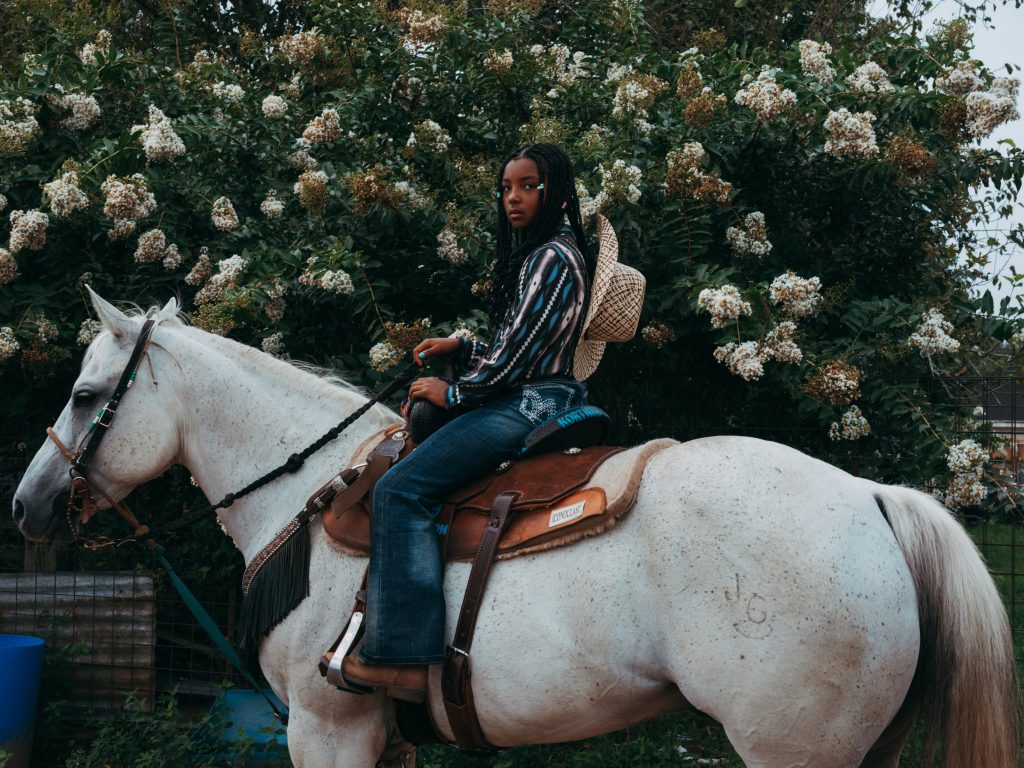
That changed in 2015, when he went to a Black rodeo in Oklahoma. What he found there was not simply a historical footnote or a corrective to the movies he’d grown up watching. It was a living culture with its own style, rituals, personalities, athleticism, faith, fashion, and sense of community. He was hooked. What began as an interest became an obsession, then a body of work that has taken him across the country, from Oklahoma and Texas to California and beyond, photographing rodeo athletes, ranchers, farmers, families, and the people who make up a much larger Western culture than the familiar mythology would suggest.
The resulting project, Eight Seconds, first became a book in 2024 and has since grown into something considerably larger. McClellan’s work has appeared in publications ranging from The Washington Post and ESPN to Elle, i-D and Dazed, and has been exhibited in museums and galleries including the Buffalo Bill Center of the West, where he had his first solo museum exhibition in 2022. He has also collaborated with Western brands including Wrangler, Stetson and Ariat, bringing Black rodeo athletes, ranchers and farmers into visual campaigns that have historically offered a much narrower picture of who gets to inhabit the West.
An expanded edition of Eight Seconds, Legacy in Motion, brings together previously unpublished photographs and continues a project that McClellan clearly has no intention of treating as finished. But the power of the work isn’t simply that it shows us Black cowboys. It is that it makes us reconsider why we didn’t see them before.

The American cowboy is one of the country’s most durable visual inventions. He is independent, resilient, physically capable, self-sufficient, slightly mysterious. He sits on a horse against an enormous landscape and somehow becomes an embodiment of the national character. McClellan has spent years thinking about how that image was constructed, from Buffalo Bill Cody’s early Western spectacles to the Marlboro Man and the Hollywood heroes who turned the cowboy into an international symbol. The historical reality was always more complicated. Black cowboys were part of the West, as were Black farmers, ranchers, lawmen and soldiers. But the mythology that survived on screen and in advertising became increasingly white.
McClellan points to Bass Reeves, the Black U.S. marshal who became one of the most successful lawmen of the American West, as an example of how much history can disappear when the people living it don’t have the means to record it themselves. Reeves could not read or write. His extraordinary life survived largely through the stories other people told about him. McClellan sees a responsibility in his own work to do something different: to document obsessively, to create a record that cannot be so easily dismissed or lost.
That makes his camera a kind of historical instrument, but he isn’t interested in pretending that photography is an objective machine. In fact, McClellan is unusually candid about the fact that he is constructing a mythology of his own.
“I’m not in the business of honesty,” he says. “Authenticity matters. Which is different.”
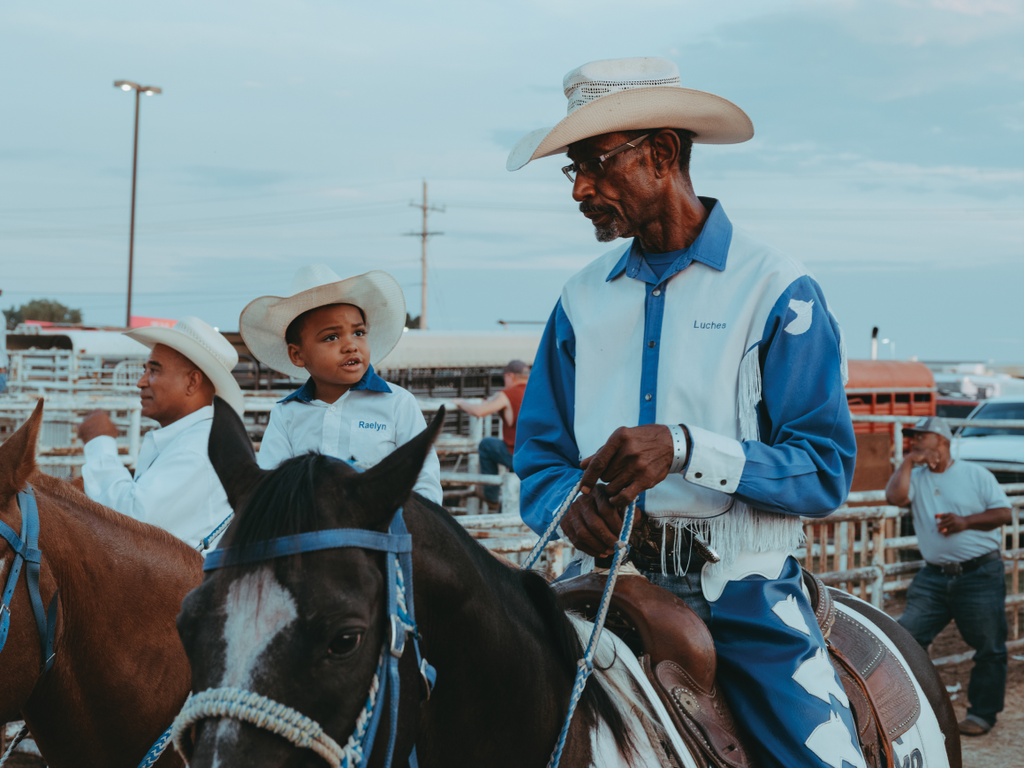
It is an important distinction. Documentary photography often carries an expectation of truth-telling, as though the camera’s job is simply to reveal what is already there. McClellan’s work is more complicated. He edits. He chooses. He waits for the right gesture, the right posture, the right light. He photographs people in ways that make them larger than life because, in his view, they are larger than life.
“I am building a collection of a bunch of cool ass people sitting on horses,” he says. “And they’re extraordinary, and they’re youthful, and they’re somebody you want to, at best, be around but could never aspire to be because, you know, you’re not that cool.”
This is where his work becomes interesting through his specific lens. A frame doesn’t simply determine what we see. It determines what we understand to be worth seeing.
McClellan is not interested in replacing the cowboy mythology with an entirely different one. He loves the old pictures. He loves Tombstone. He loves the Marlboro Man. He even describes a moment when he shared a stage with Norm Clasen, the photographer behind many of Marlboro’s iconic campaigns, and felt almost irreverent following him. Clasen had explained the visual language of the Marlboro Man: the landscape, the clothes, the atmosphere, the sense of a person looming large against the West. McClellan’s response was essentially: yes, and. “I’m just remixing it and reappropriating it and filling it out,” he says. “I’m completing the narrative.”

That may be the most useful way to understand what his photographs are doing. They aren’t asking us to forget the American West we know. They’re asking us to recognize that the picture was never complete from the beginning.
The same instinct extends to the way McClellan thinks about Black identity. He is wary of the tendency to turn any community into a shorthand version of itself, to assume that one person’s experience can stand in for everyone. Even within Black cowboy culture, there are enormous differences between rodeo riders, trail riders, farmers, and ranchers. The people he photographs don’t necessarily agree on what constitutes a “real” cowboy. They argue about it, tease each other about it, and carry their own ideas about what the culture means. For McClellan, that complexity isn’t a problem to solve. It’s the point.
He describes the temptation to tell stories about Black people by reaching for familiar tropes: violence, poverty, family conflict, and struggle, when the more interesting story might be the one that hasn’t already been told. The cowboy world offers precisely that opportunity because it doesn’t fit neatly into the dominant templates of Black American storytelling. Here are people whose lives are shaped by horses, land, competition, faith, fashion, family, work, and community. There are women with braids and acrylic nails riding horses. Men in gold chains and Jordans. Older cowboys in immaculate Stetsons and pinky rings. There is barbecue, Zydeco, athleticism, ritual, style, and an enormous amount of hospitality.
McClellan remembers arriving at that first rodeo in Oklahoma after a period of feeling isolated in Portland, where he had worked in advertising and often found himself the only Black person in the room. At the rodeo, he experienced something almost opposite: people immediately welcomed him, fed him, told him their stories, and invited him into their lives. He was struck not just by what he saw but by how it felt to be there.
“It was just such a warm reception, and like the opposite of what my life was in Portland,” he remembers. “And outside the material and the stories that I collected and this whisper in the back of my head that this is going to change the world. This is because I had no idea where it was going to come. The thing that really hit me in the chest was that feeling of belonging and that feeling of hospitality.”
That feeling eventually changed the nature of the work itself. What began as observation became relationship. McClellan’s subjects became friends. One of those friendships, with bull rider Ouncie Mitchell, made particularly clear how far the project had moved beyond photography. After Mitchell was murdered, McClellan realized that he wasn’t simply documenting a culture from the outside. He was part of a community.
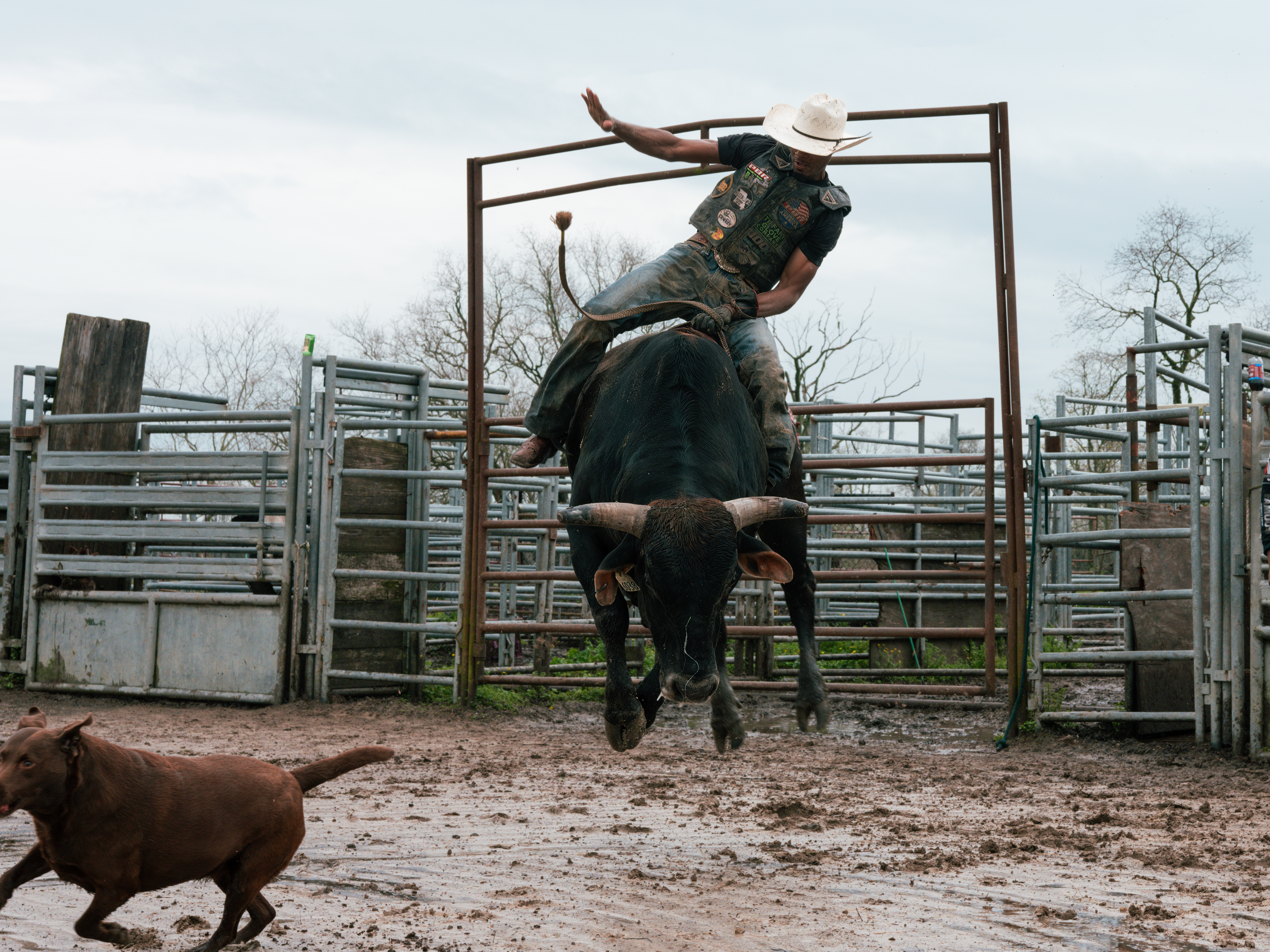
His response has been practical as much as emotional. McClellan founded the Eight Seconds Rodeo and has put hundreds of thousands of dollars back into the culture through prize money and training programs. The work has become a form of investment: if these athletes are willing to risk their bodies for something they love, he wants them to have a better chance of making it worthwhile. There is a deep generosity in that that also changes the meaning of the photographs. They aren’t simply pictures of a community. They are part of an ongoing relationship with one.
And that may be why the images feel so alive. McClellan isn’t arriving to extract a story and leave. He keeps coming back. He keeps photographing. He keeps discovering another layer of the culture that he didn’t know existed.
That curiosity has become central to his understanding of storytelling. He doesn’t want to tell the definitive story of Black cowboys because he doesn’t believe there is one. He wants to keep making room for more stories. “Let’s, as storytellers, be honest,” he says. “And let’s, as storytellers, never aim for the median or at least the perceived median, because there’s something about your story that no one has ever heard.”
It’s a deceptively simple argument for specificity. So much seems to be optimized for broad appeal, while McClellan is making the case for the opposite: that the strange, particular, highly specific story may be the one with the widest emotional reach precisely because it isn’t trying to be everything to everyone.
Hollywood has not always agreed. McClellan has tried to develop film and documentary projects around Black cowboy culture and repeatedly encountered the same objections: the subject is too niche, the audience is too small, the concept isn’t expandable enough. In other words, it doesn’t fit the lens Hollywood has constructed around Black narratives, and who wants to watch them.

McClellan’s photographs offer another model. Instead of making Black cowboy culture legible by translating it into something more familiar, he makes the culture itself the thing worth becoming familiar with. Instead of asking how it might appeal to everyone, he asks what happens when people are given the chance to become curious.
The result is a body of work that is simultaneously documentary and mythology, history and invention, archive and fantasy. It makes the American West feel both more recognizable and more strange. The cowboy remains the cowboy. The landscape is still enormous. The horses are still beautiful. The clothes still matter. The myths still work. There are simply more people in the picture now.
That is what good reframing does. It doesn’t always replace the image. Sometimes it pulls the camera back just far enough to reveal what was standing outside the edge of the frame all along.
Footnotes: FYI, The West Was Always a Remix
The cowboy may be one of America’s most recognizable cultural figures, but the image was never entirely American, or entirely fixed. Much of what we think of as cowboy culture comes from the Mexican vaquero tradition. Spanish settlers brought cattle and horsemanship to Mexico, where those practices evolved before moving north into what became the American West. Even “rodeo” has Spanish roots.
The West was also shaped by Indigenous horse cultures, Black cowboys, women, Chinese immigrants, and others whose stories were largely edited out of the popular picture. Black cowboys, for example, were an important part of the cattle industry after the Civil War, while figures like Bass Reeves became legendary lawmen.
Then came the mythmakers: Wild West shows, dime novels, Hollywood, and eventually advertising. Each took the real West and made it more theatrical, more legible, and, increasingly, whiter. The Marlboro Man was essentially the final edit: cowboy reduced to hat, horse, landscape, and rugged American independence.
But the image keeps getting remixed. Fashion borrows it. Music reclaims it. Artists reinterpret it. Beyoncé’s Cowboy Carter is only the latest reminder that the Western story has always been more complicated than its most familiar version. There was never one authentic West. There were, and are, many. The mythology just keeps changing depending on who gets to tell it.