

Rebecca Carroll on Writing the Self
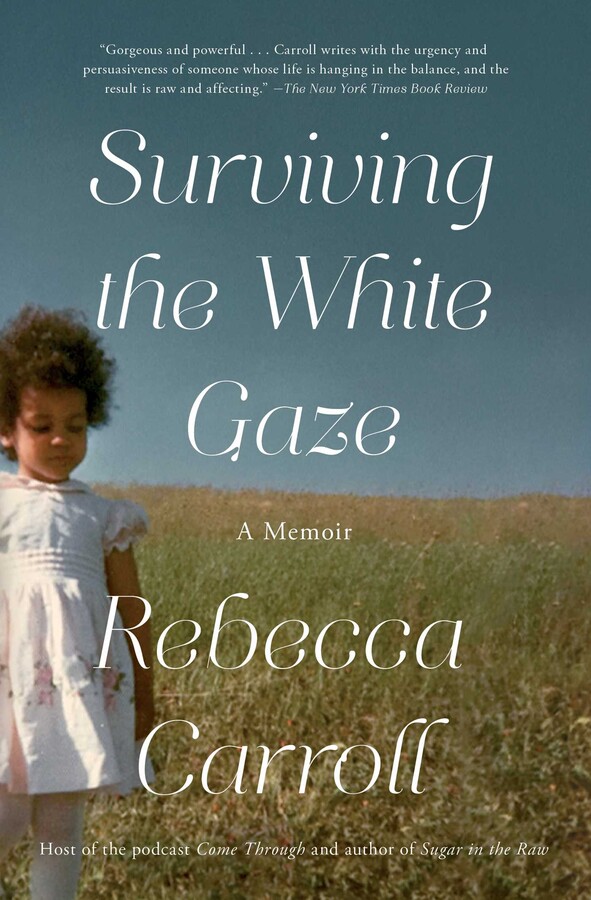
To write a memoir is to make a decision about what to remember, and perhaps more importantly, what it means to live with what you remember and then share it with the world. In Surviving the White Gaze, writer Rebecca Carroll undertakes that work with clarity and precision, tracing her experience as a Black woman adopted into a white family and the lifelong negotiation between visibility and erasure that followed.
Rebecca has long been a distinct voice in American cultural criticism, writing for publications such as The Guardian and the Los Angeles Times, where her essays often move between the personal and the political. But Surviving the White Gaze marks a shift inward. It is not simply an extension of her earlier work, but a deeper excavation, one that demands a different kind of attention, a different kind of endurance, one not every writer is equipped to undertake.
Memoir, as a form, resists distance. It collapses the boundary between writer and subject, asking not only for reflection but for immersion. It is an act that requires both discipline and vulnerability, structure and surrender. And as Rebecca makes clear, it is not something one can casually prepare for. It is something one must be willing to enter fully, knowing that the work will not leave you unchanged.
“I don’t know that it’s possible to prepare yourself for that,” she says. “I think that you are either inclined to do that kind of work or not.”
That inclination, she suggests, is not about craft alone, but about a willingness to confront the weight of one’s own interior life. To write a memoir is to invite memory back in, not as a distant reference point, but as a constant presence. “Once you invite memories into your brain, into your heart, then they’re part of the memory family that you live with all the time,” she says. “They’re just like that one member of the family that won’t shut up.”
This is where memoir diverges from other forms of writing. It is not simply an act of recalling, but of reinhabiting. And that reinhabiting can be both generative and destabilizing. Rebecca describes the process as, at times, overwhelming, a flood of recollection that resists containment. Yet within that intensity, there is also a kind of creative alignment. “Once you get the cadence and once you find the truth of it and the rhythm of it, it’s like… it felt like I was singing.”
The language of rhythm is not incidental. For Rebecca, writing is deeply sensory, rooted in the visual and the tactile. Memory is not abstract, but embodied. A single line in a childhood journal can open into an entire scene, such as her ballet classes. “I can see what my tights looked like, what my bag looked like, what the backseat of the car looked like,” she says. “That’s just how my brain works.”
But memory alone is not enough. Memoir requires selection, a shaping of lived experience into narrative form. “You could write a bajillion things,” Rebecca says. “But you have to have a through line. You have to have a central thread that can sew everything together.”
In Surviving the White Gaze, that thread is explicit. Each memory, each scene, is measured against the central question of what it means to live under the pressure of the white gaze. If it does not serve that inquiry, it does not remain. This is not an act of omission for the sake of neatness, but of discipline. A recognition that meaning emerges through focus.
And yet, for Rebecca, the idea that some stories should remain untold is less compelling. “I don’t believe anything should be in silence,” she says. “So long as we’re able to convey and communicate, nothing should be in silence.”
That insistence carries particular weight when considered through the lens of Black women’s writing. Memoir, in this context, is not only personal but cultural, shaped by histories of erasure, misinterpretation, and overexposure. Rebecca resists the expectation that her work must translate itself for a presumed audience. “I’m good,” she says. “Y’all can Google it.” The work, instead, is grounded in a different orientation. In speaking about writing for Black women, she says, “I have always found that I’m writing for us. And I’m writing to us and with us. We’re writing for each other.”

This sense of writing within a shared context reshapes the stakes of memoir. It becomes less about explanation and more about recognition. Less about making oneself legible to others and more about speaking in a voice that does not require permission. For Rebecca, the process of writing Surviving the White Gaze was, in part, an arrival at that clarity.
If memoir demands confrontation, it also requires a particular kind of generosity. Not toward the reader, but toward the self. “You have to be really generous with yourself and your heart,” she says. That generosity allows for complexity, for contradiction, for the possibility that understanding is not fixed but constantly evolving.
It also acknowledges the emotional cost of the work. Memoir, often framed as cathartic, can just as easily reopen wounds. “It can be very liberating, but also re-traumatizing,” she notes. The process of writing reshaped not only her relationship to her past, but to the people within it. Some relationships fractured. Others had to be rebuilt in new forms. “You can’t reel it back in,” she says. “You’re going to have to figure out what it looks like after all of this stuff comes to light.”
At the level of craft, Rebecca describes memoir as a balance between two positions: the keeper of the story and the witness to it. “I tried every day I sat down to write to have a conversation between those two,” she says. To be the keeper is to claim authority over one’s narrative. To be the witness is to step back, to observe, to shape. The tension between the two creates the architecture of the work.
This duality is perhaps most visible in the vividness of her scenes. Moments are rendered with a clarity that suggests both immediacy and reflection. “I remember the temperature. I remember the headlights,” she says, recalling a scene from the book. The act of remembering becomes, in itself, a form of composition.
For emerging writers, particularly Black women navigating whether and how to tell their stories, Rebecca’s guidance is both practical and grounded. The work does not begin with the full arc of a life, but with attention. “Find a memory that is the most vivid memory,” she says. “Sit down and describe it and see where that takes you.” Sensory detail becomes a way in, a method of grounding the abstract in the tangible. “Smells of things, music… will take you right there into a certain era.”
What emerges from this approach is not just a method, but a philosophy. Memoir is not about documenting everything. It is about choosing, shaping, and returning. It is about understanding that the story you tell is one version among many, and that its power lies in its specificity.
The exercise of writing a memoir, then, is not simply to tell a story about one’s life. It is to enter into a sustained relationship with that life, to examine it from multiple angles, to accept both its clarity and its ambiguity. It is work that asks for honesty, endurance, and a willingness to remain open.
And for those who are inclined toward it, it offers something rare. Maybe not resolution, exactly, but a deeper understanding of what it means to live with one’s own story, and to shape it, deliberately, into language.
learn more about Rebecca and her work here.
images: courtesy of Jamie Magnifico
Footnotes: Memory, Narrative, and the Refusal to Translate
Memory does not arrive as story. It arrives in fragments, images, sensations, often without order or any resolution about where they fit. The work of memoir is not simply to recall, but to shape. It asks the writer to move between two positions at once: the one who lived the experience and the one who can step back and give it form. In this sense, memoir is less about accuracy than about meaning. It is the act of deciding what a memory does, not just what it is.
The shaping is never neutral. To write about one’s life is also to write about others, to fix moments in language that may still be shifting for the people involved. The tension between truth and responsibility is part of the form itself. As Rebecca Carroll suggests, once something is written, it cannot be contained again. The story enters the world with its own consequences.
For Black women writers in particular, memoir carries an additional dimension. The question is not only what to say, but who it is for. Toni Morrison famously resisted the expectation to center a white gaze, choosing instead to write from within Black life rather than toward explanation. This refusal to translate is not exclusionary. It is a form of precision. It allows the work to remain grounded in its own context, its own language, its own truth.
In this way, memoir becomes both personal and collective. It’s a practice of remembering, and a decision about how that remembering will be shared.