Can Artists Tell the Truth About a Nation?
The United States is inching closer to its 250th birthday this week, and the country finds itself mired in a circular argument not simply about politics, but about memory itself. Americans are increasingly divided over the future as well as the meaning of the past: which histories deserve emphasis, which figures deserve celebration, which injustices demand acknowledgment (and atonement), and what exactly belongs in the canon of the National Story.
Under the current administration, questions surrounding patriotism, education, monuments, archives, and cultural memory have become central political concerns (or distractions, depending on the day). The anniversary arrives at an unusual moment, one in which the country appears less interested in celebrating a shared history than in debating whether such a history ever truly existed. The problem is that nations, like people, are rarely reliable narrators of their own histories.
History is often presented as a collection of facts, but it is equally a collection of decisions. What gets remembered and what gets forgotten? Which events become symbols and which disappear into footnotes? Which people become protagonists and which remain outside the frame entirely? Every nation constructs stories about itself, and those stories often reveal as much about the present moment as they do about the past.
This is perhaps where artists enter the chat in a particularly interesting way.
Artists are not historians, nor should they be expected to function as neutral observers. Their work is shaped by perspective, interpretation, emotion, and experience. Yet because of that subjectivity, artists often preserve dimensions of history that institutions struggle to hold onto. Official archives can tell us what happened. Artists are often better equipped to tell us what it felt like to the people on the ground.

Jacob Lawrence’s Migration Series remains one of the clearest examples of this distinction. The paintings document the movement of millions of Black Americans from the South to northern cities during the Great Migration. But they also communicate something larger than demographic change or historical fact. Through rhythm, color, repetition, and movement, Lawrence captured uncertainty, ambition, exhaustion, and hope. The work transformed an historical event into a human experience.
Photography has often occupied a similarly complex position between documentation and interpretation. Dorothea Lange’s Migrant Mother has become one of the defining images of the Great Depression, not because it explains the economic crisis but because it gives that crisis a face. Gordon Parks later provided the same service throughout his career, documenting segregation, inequality, and American life with an attention that resisted simplification. His captures preserved injustice, certainly, but they also preserved dignity, humor, aspiration, and intimacy. They complicated the version of America many preferred to believe existed.

Other artists have focused less on documenting national narratives than on questioning who gets included within them in the first place. Faith Ringgold’s story quilts expanded the boundaries of both art and historical record, preserving experiences and perspectives that traditional institutions had often overlooked. More recently, Kara Walker’s silhouettes and installations have fiercely interrogated the myths embedded within American history itself, forcing viewers to confront the distance between national memory and national mythology.
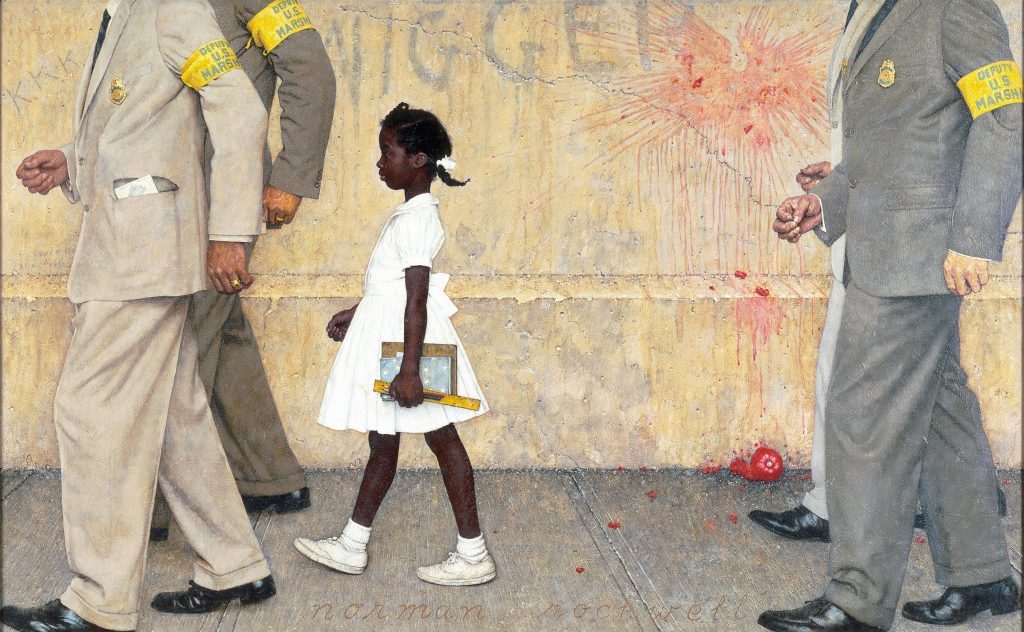
The relationship between art and truth, however, is not uncomplicated. Artists can preserve collective memory, but they can also romanticize, simplify, and reinforce myths of their own. Norman Rockwell’s paintings helped define one version of American identity for generations, even as later works such as The Problem We All Live With complicated that same vision by confronting racial inequality directly. Artists can become willing architects of national mythology just as easily as they can become its critics.
Maybe this is why the question of whether artists can tell the truth about a nation has no easy, satisfying answer. Nations contain too many histories, too many perspectives, and too many contradictions for any single voice to speak for all of them.
What artists can do, however, is direct attention. They can preserve experiences that institutions overlook, ask questions that official narratives avoid, and insist upon complexity where simplicity would be much more convenient and easier to digest. Long after commemorative campaigns fade and anniversary slogans disappear, it is often artists who remain in conversation with the messy bits of a place and its people.
It’s safe to say most of the country is not in the mood to celebrate. But perhaps the question is not whether artists tell the truth about a nation, but which truths they choose to preserve, and which truths the rest of us are willing to hear.
image: Dorothea Lange, Migrant Mother, Nipomo, California, 1936.