Stephen Campbell and The Serious Business of Joy
There are artists whose work asks you to stop and stare, and then there are artists who make you want to linger a while. Stephen Campbell belongs firmly in the latter category. Working from his studio in North Carolina, Campbell creates hand-stitched drawings that sit somewhere between illustration, textile work, portraiture, and visual storytelling. His embroidered images have found their way into collaborations with fashion and beauty brands including J.Crew, Madewell, Hugo Boss, Kate Spade, and Guerlain, while his illustrations have appeared in publications including The New Yorker and The New York Times. But the impressive client list only tells part of the story.
Campbell’s work is populated by people, clothes, food, music, places, and small everyday (and sometimes whimsical) dramas: a woman walking a pig on a leash, a Parisian street corner, someone waiting for a train, a beautifully dressed stranger, a favorite bottle of perfume. There is fashion, certainly, but also a particular kind of joie de vivre. His work seems to operate on the simple premise that the world is full of things worth noticing. That sensibility extends well beyond the studio.
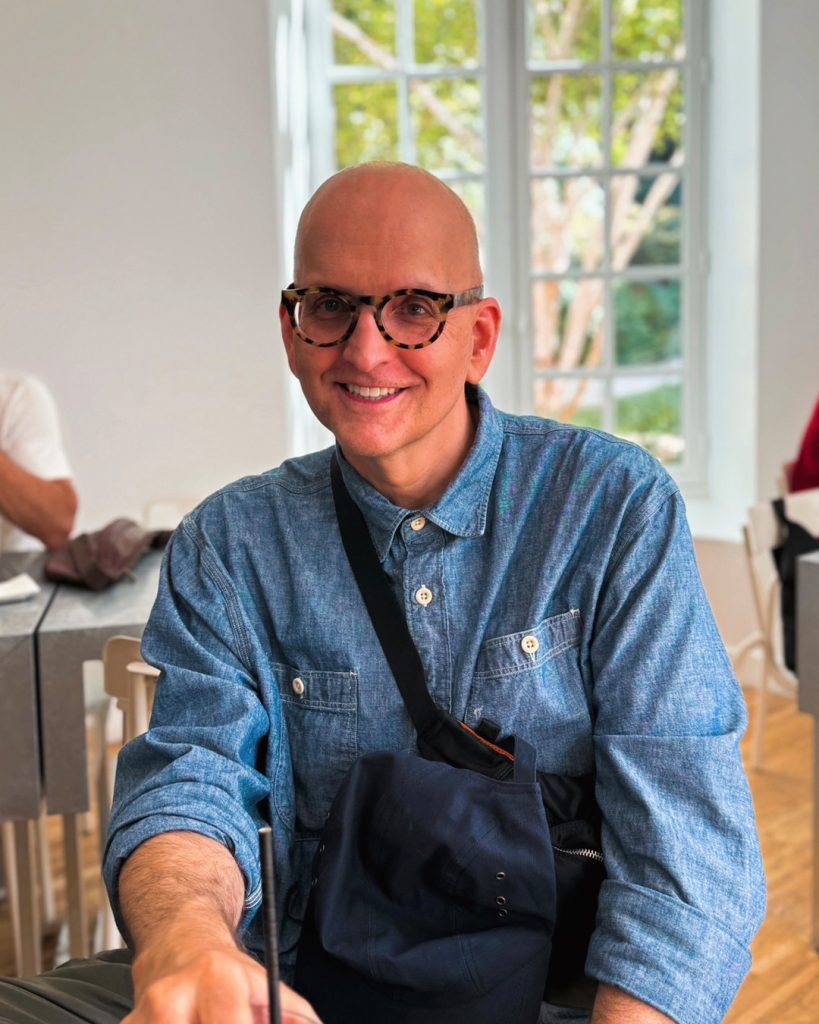
Campbell returns repeatedly to France, a place that has occupied his imagination since childhood, and collects sounds while traveling. He makes playlists with the same care he brings to a drawing, and finds inspiration in filmmakers like Agnès Varda and Jacques Tati, fashion designers like Dries Van Noten, photographers like Tim Walker, and restaurants, bookstores, record shops, and grocery aisles. His influences are less a neatly organized reference library than a wonderfully crowded room.
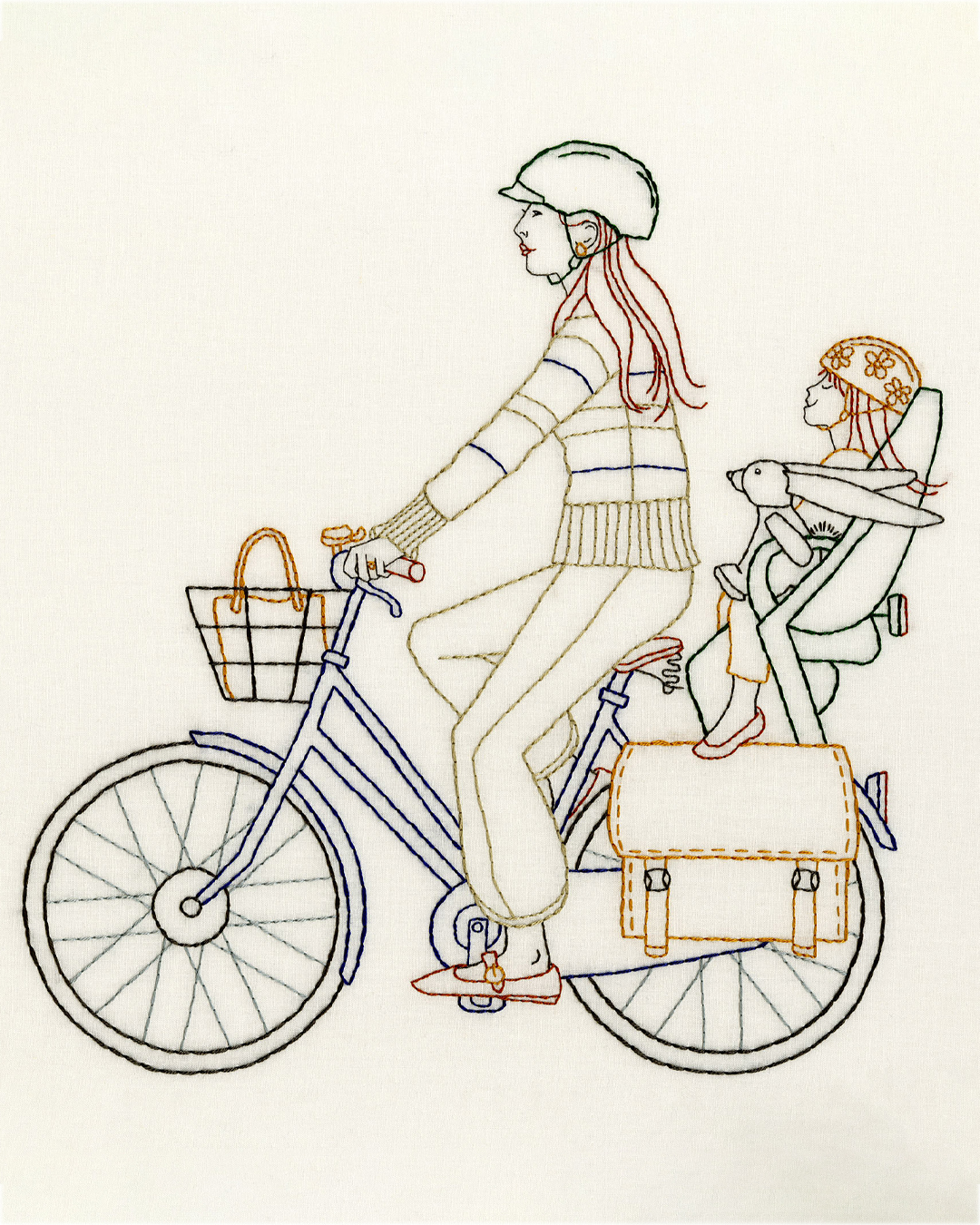
And then there is the embroidery itself. Every stitch takes time, which means every image is built through a particularly intimate form of looking. Campbell describes the act of hand stitching as moving between “meditation and anticipation.” There is the calming repetition of the needle moving through fabric, but also the anticipation of seeing the image emerge. It is not always a serene process. A tiny detail, such as a pair of lips, a hand, or a facial expression, can require hours of patience. Sometimes a line simply isn’t right and has to be cut away and started again. “That process of slowing down, reassessing, and trying again is part of the work,” he says.
Over time, that attention creates an unusual relationship between artist and image. Campbell can spend many hours with a single piece, watching a subject reveal itself stitch by stitch. By the time it’s finished, the image carries not only what it depicts but the memory of having made it. “I find myself falling a little in love with what I’m creating,” he says. This may explain why his work feels so affectionate without becoming sentimental. Campbell isn’t simply recording what something looks like. He is recording the very experience of paying attention to it.

France has been part of that visual vocabulary for a very long time. His first relationship with the country began before he had ever been there. As a child in Texas, he watched The French Chef with Julia Child after Sesame Street. Books offered another route in: Richard Scarry’s Busy, Busy World, The Adventures of Tintin, and stories that made foreign places feel vivid and accessible rather than remote. One image in particular stuck with him: Pierre, the fox policeman, riding through Paris with his navy cape billowing behind him.
Eventually, the imagined France became a real one. When Campbell first traveled to Paris with his husband in the early 1990s, he was surprised by how familiar it felt. One of his first stops was the Sonia Rykiel boutique, which he approached less like a store than a museum. For Campbell, this is part of what makes French culture so endlessly compelling. If you have traveled to France, you already know beauty isn’t confined to institutions. It appears in the typography on a package, the arrangement of pastries in a bakery window, the shelves of a grocery store, the design of a record shop, or even just the way a city street looks at lunchtime. “France reminds me that design and beauty are not reserved for museums,” he says. “They are woven into daily life.”

His relationship to the country has evolved alongside his own practice. These days, he arrives with a sketchbook, wandering away from his husband each morning to draw people on the Métro, in cafés, and on street corners. France is no longer simply somewhere he goes for inspiration. It has become, as he puts it, “an ongoing creative conversation.” That ability to find inspiration almost anywhere has served Campbell well in his collaborations with fashion brands. There is an obvious affinity between his work and fashion: both are interested in clothing, gesture, personality, and the details that allow an image to tell a larger story. But Campbell is careful to distinguish between adapting his work for a client and abandoning his own point of view.
“What draws me to fashion brands is that, at their best, they are dream-makers too,” he says. The key, he believes, is finding where his sensibility intersects with theirs. A collaboration might have a different visual language or audience, but his role is still to bring his own eye to the conversation. He compares that eye to handwriting. “Two people can write the same word, but the result will never look exactly the same,” he says. “The same is true for drawing and design.” Technique can be taught.
What makes a creative voice distinctive is harder to quantify: what someone notices, what they emphasize, what they leave out, the details that catch their attention. For Campbell, maintaining that voice ultimately comes down to trusting those instincts. It is a useful distinction during a moment when creative work can easily become overly optimized and flattened for a particular audience, platform, or client. His approach is less about developing a recognizable style and more about paying attention to the choices that already feel instinctively his.
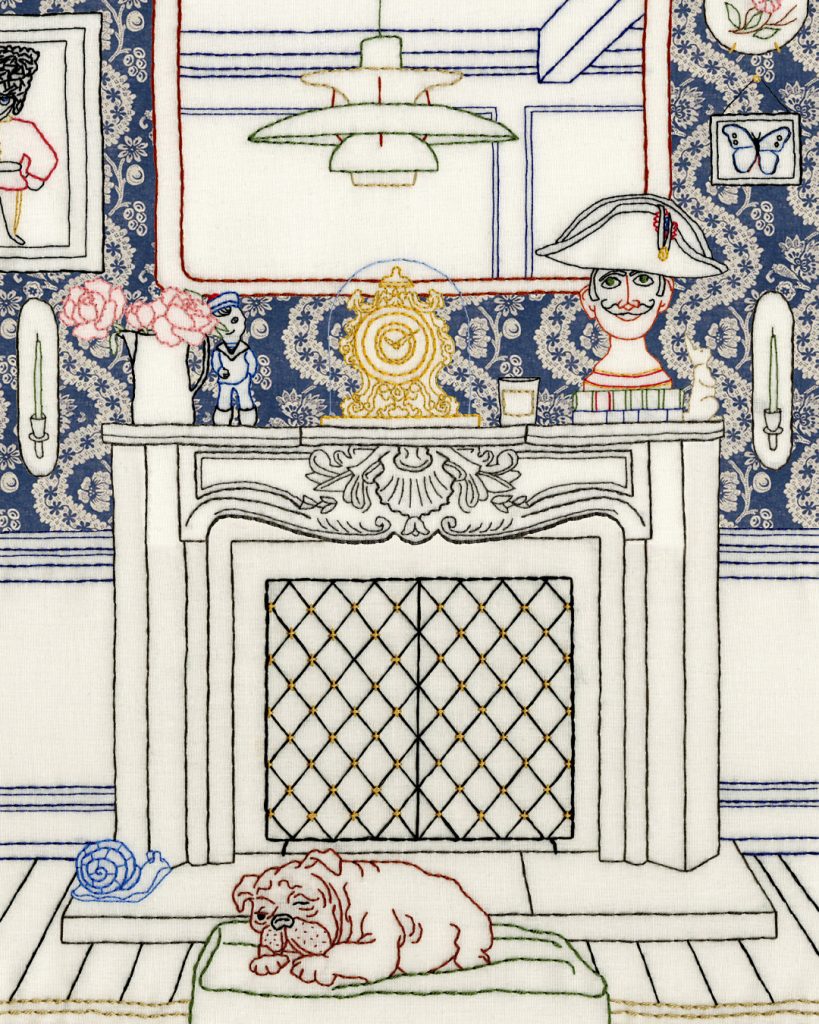
If Campbell’s drawings are a way of collecting visual moments, his playlists and sound recordings are another kind of scrapbook. Music has become an increasingly important part of his practice, partly because the visual culture around him changed. As Instagram moved toward video, GIFs, and Reels, he began wondering how his embroidered drawings might exist beyond the still image. Could a stitched portrait wink? Could it move? Could sound become part of the experience? Embroidery isn’t exactly the obvious medium for animation, which seems to be precisely why Campbell wanted to experiment with it. Some attempts worked. Others didn’t. The failures were useful too. “I’ve always been curious about the possibilities that live just beyond what I know how to do,” he says.
That curiosity extends into the music he listens to while working. Kate Bush, Agnes Obel, Mathieu Boogaerts, Róisín Murphy, Albin de la Simone, Clou, and even The Crown soundtracks have all found their way into his studio rotation. But Campbell’s playlists aren’t simply background music. He thinks about them as compositions, paying attention to transitions and the emotional movement from one song to the next. He grew up in the era of the mixtape, when choosing a song for someone was itself a form of communication. Streaming may offer infinite playlists, but Campbell still values the human hand behind the selection.
He has also become something of a sound collector. When traveling, particularly in France, he records the everyday noises around him: café cups clinking, Métro wheels, airport announcements, train doors closing. These recordings function almost like photographs. “A single familiar noise can instantly transport me back to a Paris street corner, the open air market, or a perfect afternoon that might otherwise have been forgotten,” he says. It is the same impulse behind the drawings: preserving something fleeting before it disappears.
That instinct to notice people may have deeper roots in Campbell’s earlier career. Before working full-time as an artist and illustrator, he worked as a creative arts therapist with medically ill children and their families in a New York City public hospital. The experience exposed him to people from an extraordinary range of backgrounds and circumstances. It also reinforced something that now feels central to his work: everyone carries a story. Campbell doesn’t draw people to make them exotic or mysterious. He is interested in the details that make someone recognizable: their clothes, gestures, expressions, habits, and peculiarities. “When I draw or embroider someone, I’m rarely interested in creating distance or exclusivity,” he says. “Instead, I’m interested in creating recognition.”
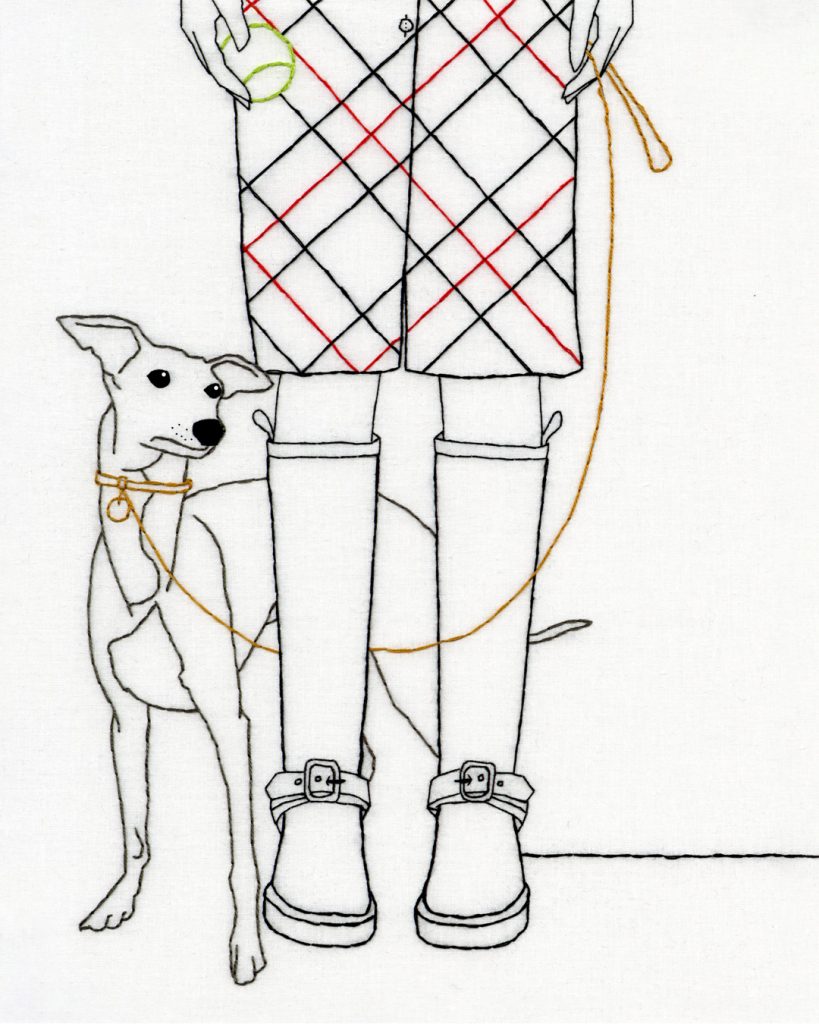
That recognition is part of what gives the work its warmth. His images are specific enough to feel like they belong to a particular person or place, but open enough for viewers to project themselves into them. The invitation is simple: you’ve seen this person. You’ve had this moment. You know this feeling. Given how many different forms his practice already encompasses, it makes sense that Campbell’s dream project isn’t simply an exhibition of framed drawings. He imagines something closer to an entire environment: large and small embroidered works, sound, music, dialogue, and movement, all existing together.
Visitors might encounter a drawing of someone reading and hear pages turning. A café scene might come with the sound of cups and distant conversation. The entire space would feel less like a gallery than an apartment building populated by the characters and observations that have accumulated throughout his life. “A living sketchbook,” he calls it. It’s a fitting description for a practice that seems to resist keeping things in separate boxes. Drawing becomes embroidery. Embroidery becomes animation. Music becomes memory. A trip to Paris becomes a sketchbook. A sound becomes a souvenir. A fashion collaboration becomes another opportunity to tell a story. The common thread is attention.
There is a lot of irony in contemporary visual culture. There is also a lot of cleverness. Campbell’s work is refreshingly uninterested in either for their own sake. Instead, it is joyful; not joy as a sugar coating, but joy as a practice of paying attention. Campbell begins working at his desk every morning at 7:30. He draws when there isn’t a client project waiting. He stitches. He collects. He looks. He follows things that interest him. “People often associate creativity with inspiration alone,” he says, “but my experience has been that joy is built through practice.”
Joy, in Campbell’s understanding, isn’t passive. It requires showing up. It requires being curious enough to notice the woman walking a pig down an East Village street. It requires caring about the typography on a package or the sound of a Métro door. It requires looking at a beautiful meal and deciding that the arrangement of it is worth remembering. “Joy is setting one more place at the table for an unexpected guest,” he says. It’s a line that could almost serve as a manifesto for his entire practice, because ultimately, Campbell isn’t asking us to look at the world differently so much as to look at it more closely.
Taste, he says, is built through thousands of these small moments of attention. Some are inherited. Some are taught. Most are simply collected along the way. His grandmother taught him to make biscuits with buttermilk and a handful of ingredients. France taught him that beauty could live in the everyday. Fashion taught him about the power of a detail. Music taught him about sequence and atmosphere. His work with children taught him to look at people with curiosity and respect.
And now he stitches those things together, not literally, of course, although sometimes literally. The result is a body of work that makes a convincing case that a creative life isn’t necessarily built from grand gestures. Sometimes it’s built from noticing the small things, loving them a little, and deciding they’re worth keeping.
learn more about Stephen and his work at stephencampbelldraws.com.
top image: Brooklyn Commuters for Eighty-Nine DeKalb (Brooklyn)