The Invisible Infrastructure of Creativity: The Grocery Aisle
When we think about the places that shape creative lives, grocery stores probably aren’t the first to come to mind. Museums, bookstores, galleries, and record shops have an obvious cultural pedigree. Grocery stores, by comparison, are where we go to buy eggs.
But pay closer attention, and it becomes clear that grocery stores do much more than keep us fed. They are places where culture becomes visible, tangible and, perhaps most importantly, accessible. Food is one of the few forms of culture that almost everyone understands. You don’t need to know anything about art history to be curious about a beautiful package of tea. You don’t have to consider yourself an adventurous eater to notice that an entire aisle of a supermarket looks completely different from what you’re used to. And you certainly don’t need a sophisticated palate to appreciate an impeccably arranged display of fruit.
Basically, food meets us right where we are.
This is part of what makes grocery stores such interesting creative spaces. They are full of visual information, but they don’t announce themselves that way. Typography, color, illustration, photography, packaging, architecture, merchandising, and display all compete for our attention, often without us consciously registering any of it. A beautifully designed box of candy sits beside a plastic package of something engineered to survive three months (or more) in a pantry. Both are communicating something, and both can be interesting.
Spend an afternoon wandering through an H Mart and the experience becomes clear. The scale alone can be a little overwhelming in the absolute best possible way: unfamiliar ingredients alongside recognizable ones, shelves of noodles, sauces and snacks, elaborate displays of seafood, rows of colorful packaging, fruits you’ve never bought before sitting beside the apples you could identify in your sleep.
There is something wonderfully democratic about it. You can arrive looking for soy sauce and leave wondering what, exactly, you are supposed to do with a package of dried seaweed shaped like a small architectural model. The point isn’t necessarily to buy it. The point is that you saw it.
That bit matters. Creativity often begins with the first exposure before it becomes expertise. We encounter something before we understand it. We notice a color combination, a material, a form, a word, a flavor, a ritual. You file it away somewhere, then later, it resurfaces in a completely different context.
Grocery stores are particularly good at these kinds of encounters because they contain so many different levels of culture at once. There are handmade cheeses wrapped in paper, industrially produced cookies in extremely persuasive packaging, jars of preserves made by a small regional producer, a bottle of mass-market soda, fresh flowers, frozen dumplings and a dozen varieties of something you can’t identify. The artisan and the mass-produced coexist without much concern for hierarchy.
This is one of the things that makes grocery stores abroad so endlessly fascinating and stimulating. A supermarket in Paris, Tokyo, Mexico City or London can reveal an enormous amount about a place without ever attempting to explain itself. You learn what people eat, how they shop, what they consider convenient, what they consider special, what gets packaged and what doesn’t, what is displayed prominently and what is tucked away.
You can learn how cultures view the food cultures of other countries. If you ever wondered what the French think Americans eat, stroll through the “Les États-Unis” section of La Grande Épicerie on the Left Bank of Paris. Old El Paso-branded products stretch as far as the eye can see, alongside mac and cheese– in a can.
You might also notice that butter comes in a different shape. That yogurt has an entirely different visual language, and the cereal aisle seems almost comically small. That a neighborhood bakery sells bread in a way that makes the bread aisle at home feel criminally overproduced. Or that a seemingly ordinary convenience store contains an entire universe of snacks you’ve never encountered.
None of this requires translation. Food is a remarkably effective cultural ambassador because the basic premise is universal: we have to eat. That universality makes food an unusually generous entry point into cultures that might otherwise feel unfamiliar. You can begin with something as simple as curiosity. What is that? How do people eat it? Why is it packaged that way? Why are there seventeen kinds? What does everyone here seem to know that I don’t?
Those questions may sound small, but they are the same questions that drive creative thinking. What else is possible? Why does it work this way? What happens if we look at it differently? And grocery stores reward looking in a uniquely specific way.
There is something useful about the fact that they are not designed primarily for inspiration. They are designed for efficiency. You are supposed to get what you need and go home. But the best creative discoveries often happen when we wander away from the original assignment: you went in for coffee. You left with a strange magazine, a beautiful tin of sardines and an idea for a color palette.
This is also why the humble packaging on grocery shelves deserves more attention than it gets. Food brands have to make themselves understood quickly. Their packages have to communicate flavor, quality, origin, personality and desire, often in the few seconds it takes someone to reach for a jar. Some do it through exquisite restraint. Others deploy color with the subtlety of a marching band. Both approaches can be revealing.
The grocery aisle is essentially a giant, constantly changing exhibition of visual persuasion. Commercial, yes, but it’s also cultural. It tells us what a society values, what it finds beautiful, what it considers nostalgic, what it considers modern, and what it wants us to believe about ourselves.
And because food is so closely tied to memory, these visual cues can be remarkably powerful. A particular package can transport you to childhood. A smell from a bakery can bring back a trip. A bottle of something you haven’t seen in years can suddenly make an entire place feel close again. In this sense, grocery stores don’t just introduce us to new things. They help us understand where we are, and sometimes where we’ve been.
Perhaps that is why the most interesting grocery stores can feel a little like museums, except everything is for sale and you are encouraged to eat the exhibits. They are repositories of taste, certainly, but also of design, history, geography and everyday ritual. They remind us that culture doesn’t only live in the places we designate as cultural. Sometimes it is sitting on a shelf between the crackers and the canned tomatoes.
And for anyone interested in creativity, that may be the real lesson. We don’t need to travel to the ends of the earth, visit every gallery or read every book to remain curious. It could be enough to just walk into a place where we don’t know everything. Look around. Pick something up. Read the label. Ask what it is. Maybe buy it. Or don’t. The important thing is that you noticed.
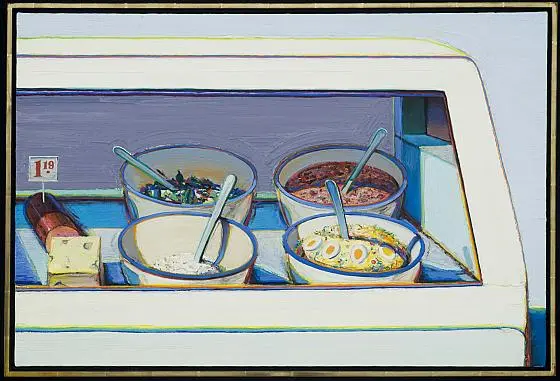
image: Wayne Thiebaud, Food Bowls, oil on canvas, 2005.