Louis Armstrong in Ghana and the Life Beyond the Image
There is the Louis Armstrong most of us know: trumpet raised, cheeks full, eyes bright, smiling into the camera. The unmistakable voice. The songs that have become part of the American cultural canon. The image of the undeniable jazz superstar, endlessly recognizable even to people who might struggle to name a single album.
Then there is the Louis Armstrong who was bent over a desk making collages, filling scrapbooks, writing letters, documenting his travels, collecting photographs and saving the small evidence of a life lived at extraordinary speed. For Regina Bain, the executive director of the Louis Armstrong House Museum in Queens, the distance between those two images is where the interesting work begins.
“There’s the literal image that people see, the photograph, usually smiling, usually in a certain way,” she says. “And then there’s who he was when he was bent over a desk creating a collage. And you had to be in the room with him in order to experience that.”
Fortunately for us, Armstrong left a lot behind.
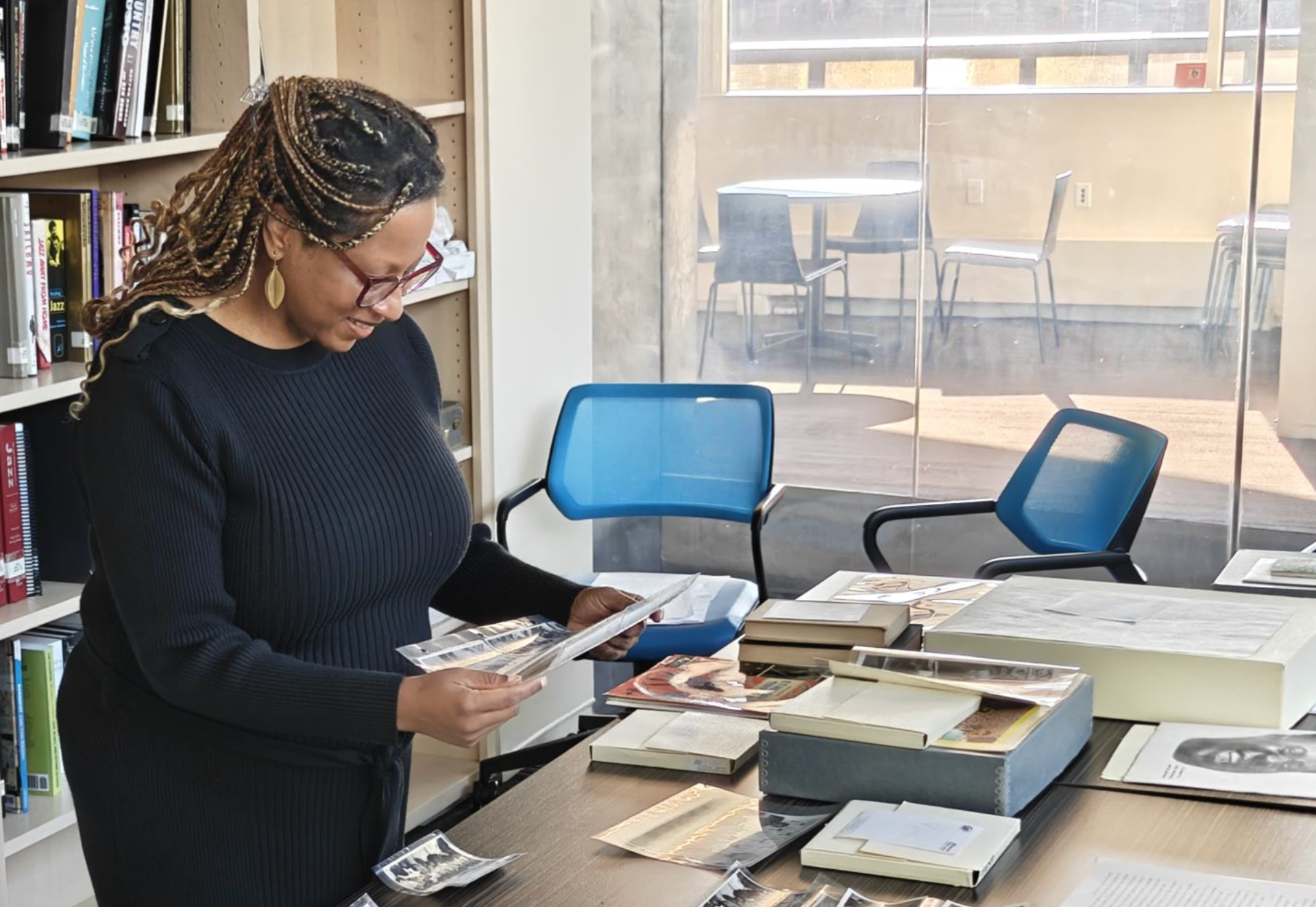
The Louis Armstrong House Museum holds the largest archive of any single jazz musician, with some 60,000 artifacts, recordings, photographs and documents preserving not only Armstrong’s career but the texture of his life. The archive has become the foundation for a new kind of museum programming under Bain’s leadership, including contemporary commissions, artist residencies and international exchanges. The museum’s 14,000-square-foot Armstrong Center, which opened in 2023, houses the archive alongside exhibition and performance spaces.
On October 1, the museum will open Armstrong in Ghana, a year-long multinational exhibition and music exchange marking 70 years since Armstrong’s 1956 concert tour to Accra. The exhibition will debut in Queens before traveling to the Nubuke Foundation in Accra in 2027, with a presentation at The Africa Center in New York. It brings archival material into conversation with newly recorded oral histories and newly commissioned work by contemporary artists, while expanding into performances, panels, workshops, and the museum’s Armstrong Now residency program.
The premise is deceptively simple: look at Louis Armstrong somewhere other than home.
Armstrong was born in New Orleans, began an important part of his career in Chicago, spent three decades living in New York, and ultimately traveled to more than 60 countries. His recordings traveled even farther. By the middle of the 20th century, he was not simply an American musician who happened to tour abroad. He was a towering global cultural figure, moving through countries with different histories, governments, and ideas about race.
“For a black man in the 1930s, 40s, 50s, 60s to travel the world as a superstar, a megastar, and a representative of the best that could be was very significant,” Bain says. “And he was received with open arms.”
That reception also carried a complicated weight. Armstrong was traveling as a Black American at a time when the United States was deeply segregated and increasingly under international scrutiny over its treatment of Black citizens. At home, he used his stature to push against segregation in ways that were unusually concrete. Bain points to contractual demands that venues where he performed also accommodate him and his band, as well as his insistence that audiences be integrated. Those conditions sometimes required venues in segregated countries to make exceptions.
“He was able to navigate them all and navigate them successfully and be beloved in those countries,” Bain says. Ghana offers an especially revealing place to examine that global Armstrong.
When Armstrong arrived in Accra in May 1956, the country was still the Gold Coast, a British colony approaching independence. Journalist Edward R. Murrow had arranged for Armstrong and his All Stars to travel there as part of the filming that would become Satchmo the Great. More than 10,000 people greeted him at the airport, and an estimated 100,000 attended his outdoor concert. He also performed at the Accra Opera House and shared the stage with Ghanaian highlife musicians.

It was a visit that was political without being reducible to politics, and deeply personal without belonging only to Armstrong.
At the Achimota School, Armstrong encountered a dancer who reminded him of his mother. He wrote about the experience afterward, describing a sudden recognition of himself in a place he had never been. “He said he wrote letters to different people and said, ‘This woman looked like my mother from New Orleans. I know now that I am from this place and that I belong here too,’” Bain says.
For Bain, that moment of recognition changes the meaning of the trip. Armstrong wasn’t simply bringing American jazz to Africa. He was also experiencing a kind of return. And the music was returning with him.
Armstrong’s meeting with Ghanaian trumpeter E.T. Mensah, one of the defining figures of highlife, became a meeting between two musical traditions that had traveled in different directions and were now encountering one another again. Armstrong had come to Ghana with jazz, a form shaped by the musical traditions of the African diaspora; Mensah represented the evolving sound of highlife in Ghana. Their exchange was not a one-way transmission.
“There was something personal,” Bain says. “He saw his mother in the people that he interacted with. But then there was also the music.” That reciprocal idea is central to Armstrong in Ghana. The exhibition isn’t interested in treating Ghana as a backdrop to an Armstrong story that was already written. It asks what happens when Ghana becomes part of the story itself, and what Armstrong’s presence looks like when viewed from both sides of the Atlantic.
That shift became particularly tangible for Bain when she traveled to Ghana herself with the Armstrong Archive. Because roughly 90 percent of the archive has been digitized, she was able to search Armstrong’s photographs and documents while moving through the places he had visited. At Christianborg Osu Castle, a former slave fort and later seat of government in Accra, she noticed markings that resembled images she had seen in the Armstrong archive. She went back to the records and began looking again.
What she found was not a neatly packaged story saying: Louis Armstrong visited a site of enslavement. Instead, there were images and fragments that allowed her to assemble a connection that had not previously been made explicit.
“The images that I’m seeing here look like the images of the slave fort,” she says. “But I haven’t seen any writing where it says Armstrong visited a slave fort.” That absence became an invitation rather than a dead end.
The discovery opened another layer of the Ghana story: Armstrong, the global superstar and American cultural ambassador, standing in a place where Africans had been held before being sent across the Atlantic. It also placed Bain herself within the story. This was her first time, as a Black American, visiting a site of enslavement across the ocean. “And it was really interesting to explore that story for him and to imagine what that might have been like for him and his band, but also to think about it for me,” she says.
This is where the archive becomes something more than a repository of historical evidence. It becomes a space where new relationships can be made between things that were always there but had not necessarily been placed beside one another.
That is also why contemporary art is such an important part of the exhibition.
Bain doesn’t want artists to simply illustrate Armstrong’s history. She wants to put the archive in front of them and see what they notice. “I’m gonna let them tell us,” she says. “What I saw when I visited the slave dungeon was that wall. And then I saw a piece of art by Kaloki Niyamai. He’s actually a Kenyan artist who reminded me of the wall.”
Niyamai’s work became a point of connection: a contemporary artwork that echoed something Bain had encountered in Ghana without simply reproducing it. Other artists and performers have been invited to work from the same premise. “Our task is to show them what we have, tell them the story, and then they will interpret and create on their own.”
There is a fitting symmetry in that approach because Armstrong himself was a visual artist.
His archive contains hundreds of collages and decorated scrapbook pages, as well as more than 500 tape-box covers that he transformed with photographs, newspaper clippings, handwritten notes, and other fragments. Bain sees those works not as a side note to his musical career, but as another way of understanding how Armstrong thought.
“He was a collage artist as well as an amazing trumpet player and vocalist, composer,” she says. “So I want, and we want as a museum, to share Louis Armstrong with the world in the whole of who he was as a human being and as an artistic human being as well.”
The exhibition’s contemporary artists are therefore entering into a conversation that Armstrong himself was already having: layering fragments, crossing mediums, making connections between things that might initially appear unrelated. And once you start looking at Armstrong this way, even the chronology becomes more complicated.
His Ghana visit came in 1956, one year before Ghana’s independence and in the midst of the American civil rights movement. In 1957, after Ghana achieved independence, Armstrong made an unusually outspoken public statement about the violence surrounding the effort to integrate schools in Little Rock, Arkansas. The timing invites an obvious question: Did Ghana change him?
Bain is careful not to claim an answer the archive can’t provide. “We don’t have any writing where he says this because of this experience,” she says. “But we know he had that experience, and we know he did. He made a different choice than he usually made months later.”
For her, the more interesting possibility is not proving a direct causal relationship, but thinking about how experiences accumulate. “There are conversations that take time to settle in your body,” she says, “but they come out as independence and freedom.”
That may be the most compelling idea running through Armstrong in Ghana: that travel isn’t necessarily about the moment you arrive somewhere. Just as crucial, it can be about what you bring back home.
Armstrong said yes to Ghana because Murrow wanted him to participate in a film. He could not have known that the trip would become something much larger in his life, or that seven decades later a museum would return to the archive to ask what that journey meant. “That’s life,” Bain says. “And that was Armstrong’s life. Saying yes to experiences around the world that led to new ways of thinking, of being, and led to his art.”
The museum is now doing something similar with the archive itself. Rather than treating Armstrong’s story as finished, it is allowing new artists, scholars, musicians and audiences to keep adding questions to it. That feels particularly important for a figure whose public image has become so fixed.
“Any megastar is perceived through a very specific lens and filter,” Bain says. “And it’s often only after they pass that more stories, layered stories, come out about who they were, what they thought, what experiences they had.”
Armstrong has been gone for more than five decades, but the archive keeps complicating him. The smiling photograph is still there. So is the trumpet, the voice, the records, the movies and the superstar.
But there is also the man who recognized his mother in a Ghanaian dancer. The musician who met the king of highlife. The American who stood in a former slave fort. The collage artist layering photographs and scraps of paper at his desk. The traveler whose experiences may have taken time to settle before emerging somewhere else in his life.
“Thankfully, we get to sort of be in the room because he left so much for us,” Bain says.
It’s what an archive does best: not preserve a life in amber, but keep giving us reasons to look again.
main image: Courtesy of The Louis Armstrong House Museum.