
Demon Mineral: Hadley Austin on Land, Memory, and the Legacy of Uranium Mining
Some places in America feel almost impossible to see without first seeing them in images. The American West is one of them. Monument Valley arrives already shaped by Hollywood Westerns, Ansel Adams photographs, road-trip postcards, and a mythology reproduced so often that the landscape itself can feel like part of the story.
For filmmaker Hadley Austin, that history was impossible to ignore while making Demon Mineral, her documentary about uranium mining and radioactive contamination across Diné Bikeyah, the traditional homelands of the Diné. The film moves across the Navajo Nation, connecting uranium extraction, water, land, history, and the lives of people who have lived with the consequences of contamination for generations.
But Demon Mineral is also a film about who gets to represent a place, whose knowledge is considered authoritative, and what happens when a familiar image is given a different frame. Austin calls the film an “anti-Western”. She also describes it as a tapestry, closer to a documentary essay than a conventional character-driven film. There is an emotional arc and a historical one, but no single protagonist whose story carries the film from beginning to end.
“It’s all I thought about,” she says when asked how she thought about your responsibility in framing a story that belongs so deeply to the Diné community . “It’s literally all I thought about. And if I could have made myself disappear in the entire process, I would have.” That instinct runs against much of contemporary documentary culture, where the filmmaker’s own presence has increasingly become part of the narrative. Austin resisted that model. She is not a character in Demon Mineral, and the film does not attempt to turn the issue into a personal journey. Instead, it takes a longer view.
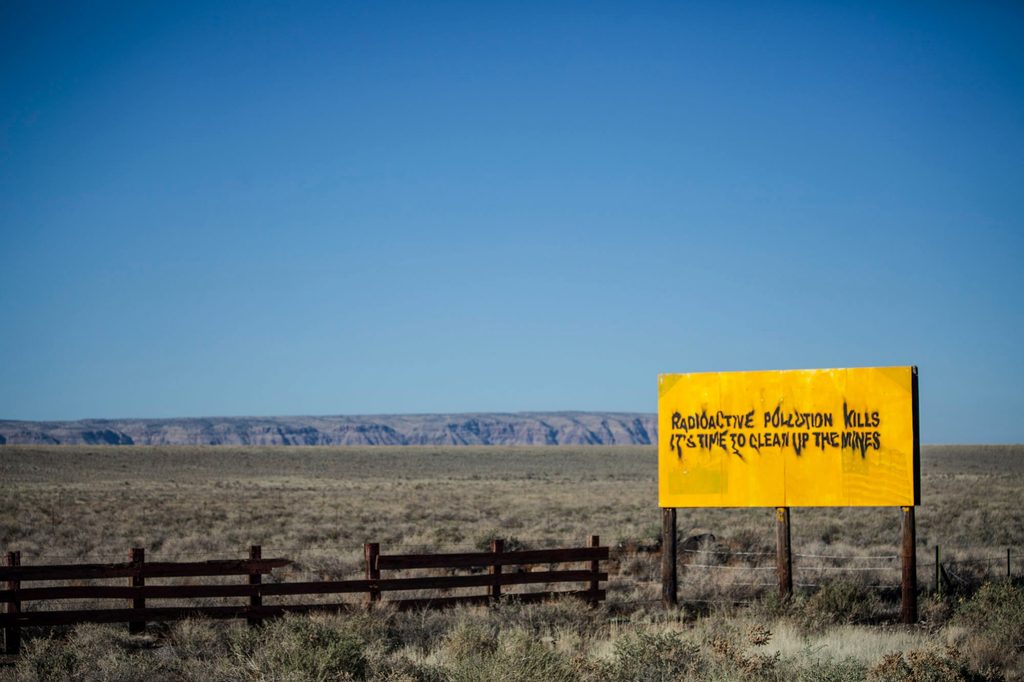
Radioactive contamination is not a problem that naturally lends itself to a neat beginning, middle, and end. It exists across generations, landscapes, political systems, and histories. Austin spent several years making the film, and the result deliberately operates on that expanded timescale.
“It’s not the kind of problem that you can just go to city hall, advocate for change, have a triumphant or negative outcome, and then wrap up,” she says. “That’s not how that kind of work happens.” The structure of the film became one way of acknowledging that complexity. So did Austin’s approach to authorship.
The majority of the film’s collaborators were Diné, and Austin created a process through which people involved in the project could review cuts, weigh in on language, and participate in decisions about how their communities and experiences were represented. Even interviews that ultimately did not make the final film remained part of what she considers its authorship. “Every single person who is in the film is an author of the film,” she says.
That approach also shaped who appears on screen as an authority. Austin consulted scientists and government agencies outside the Diné community, but made a deliberate decision that every expert heard in the film would be Diné. “One of my personal goals was that every face, every voice of authority would be Diné,” she says.
The decision comes from a larger concern about documentary itself. Films about marginalized communities can appear to offer people the opportunity to tell their own stories while still filtering those stories through an outside framework. Austin wanted Demon Mineral to resist that pattern, not simply by changing who appeared on camera, but by reconsidering the entire structure through which the story was being told. That meant reconsidering the images, too.
Austin had lived near the edge of the Navajo Nation, close to Pinyon Plain Mine, and knew that proximity did not make her an insider. She was conscious of that distinction throughout production. At the same time, she was aware that she was entering a visual landscape already crowded with representations created by outsiders.
“The images of this place that people have consumed primarily come from both Ansel Adams photography and John Wayne and John Ford westerns,” she says.
Those images carry very different histories, but both helped establish a familiar visual language for the American West. Monument Valley, in particular, has been repeatedly transformed into a symbol of the West through Hollywood cinema. Austin wanted to acknowledge that history rather than pretend it did not exist. “There’s no way to not be in conversation with the past images of this place because they’re so iconic.”
The answer was not to avoid those images, but to recontextualize them.
Demon Mineral was filmed across Diné Bikeyah, but its landscapes are rendered in infrared black and white, a choice that references the visual history of the West while introducing another layer of meaning. Infrared photography uses light outside the range of ordinary human vision. For Austin, that created a direct connection to the film’s subject: a landscape containing dangers that cannot necessarily be seen. “We were capturing danger that’s not visible to the human eye with a technology that uses light that’s not visible to the human eye.”
It’s an especially elegant example of form carrying meaning. The visual choice is not simply an aesthetic decision. It becomes a way of talking about history, technology, danger, and perception simultaneously. The landscape is recognizably the American West, but it has been pulled out of the familiar palette of the Western and made newly unfamiliar. That unfamiliarity is important because Austin was equally wary of another possible frame for the film: horror.
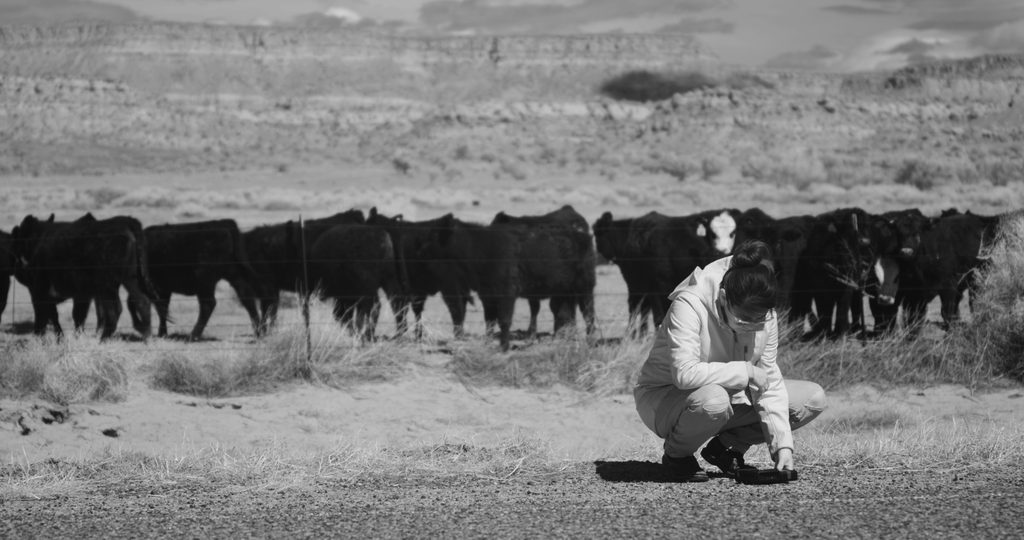
The consequences of radioactive contamination are horrifying, and Demon Mineral does not minimize that reality. The film has screened at horror festivals, and Austin sees a legitimate connection to the emerging genre of eco-horror. But she also sees a danger in allowing horror to become the only way the landscape is understood.
“What you’re doing is saying to someone that where they live and the place that they love, that the land itself, it only exists in this horror space when that’s not true at all,” she says.
For the people who live there, contamination is a persistent reality, but it is not the entirety of their relationship with the land. The landscape has its own history, beauty, cultural meaning, and daily life that predates uranium mining and will continue beyond it. That complexity is part of what makes Demon Mineral an anti-Western rather than simply a documentary about environmental damage.
“The Westerns, which some of them I really enjoy, but they are all conquest tales,” Austin says. “We don’t have the Western that tells the story from the indigenous perspective.”
Her response was to use the visual language of the Western against itself. The film contains the kinds of expansive landscapes that audiences might recognize from classic Westerns, but the narrative belongs to the people whose homeland those images have historically transformed into scenery. It is also why geography became such an important part of the film’s construction.
Rather than relying on state lines and familiar American maps, Austin chose the four sacred mountains that traditionally define Diné Bikeyah as the geographic boundaries of the story. It was an intentional effort to locate the film according to Diné geography rather than automatically placing it inside the political boundaries imposed by the United States.
The choice created its own challenge. During an early test screening, viewers told Austin they were sometimes unsure where they were. They recognized a license plate or heard English alongside Diné, but they did not have the familiar state boundaries to orient themselves.
“I was like, these people are not speaking English, but I see a license plate,” she recalls.
The problem became another version of the central question: how do you locate a place without automatically locating it through the systems that have historically defined it? Austin’s background as an educator also shaped how she answered that question. Before filmmaking became a central part of her practice, she spent years teaching, including a decade on Chicago’s West Side. She describes teaching as an education in storytelling itself, particularly the challenge of holding someone’s attention while respecting the fact that their time belongs to them.
“I’m also very aware that people are giving me their time,” she says. “And time is all we have.”
That awareness is visible in the pace of Demon Mineral. The film is deliberately slow, giving its audience room to absorb information and to look. Austin attributes that partly to the cultural context of the film, but also to a desire to let viewers stop and think rather than constantly moving them toward the next piece of information.
The slowness leaves room for beauty, humor, and ordinary life to exist alongside the film’s more difficult realities. A heavy metal band rehearses near sheep. A goat is fed. A landscape sits almost motionless as clouds pass over it. Those moments complicate the idea that the film should be understood primarily through crisis. They also reveal something about Austin’s larger approach to documentary: observation can be a form of respect.
Perhaps the most revealing example comes near the end of the film, when Demon Mineral shifts toward a more hopeful register. Austin wanted the film to acknowledge the damage done to the land without suggesting that nothing can change. Conditions have improved in significant ways, she says, even as much work remains.
The final chapter includes an animation of corn growing beneath a rainbow and rain. The sound accompanying it was created by manipulating dish soap around bubble wrap. It is an unexpectedly strange, tender, handmade moment in a film dealing with contamination, extraction, and generational harm. Austin calls it one of the film’s indulgences. There are others: long still shots in which almost nothing happens, the camera remaining fixed while clouds move across the land. Moments in which the audience is simply asked to stay.
That may ultimately be the most radical frame Austin creates in Demon Mineral. She asks us to look at a place without rushing to turn it into a symbol. Not a postcard. Not a Western. Not a horror story. Not even simply a story about contamination. A place can contain all of those things and still be much more than any one of them.
Austin resists calling the film activism. She sees herself primarily as an educator, someone presenting information and making space for people to understand what life is like in a particular place. Her own life exists between this work and the commercial production work that pays her bills: corporate headshots, commercials, event production, and other forms of filmmaking.
“I get up, and I try to do the right thing, and then I go, you know, work as an event producer or a film producer for a commercial to pay my bills,” she says. “So to you, it’s just something that you just do. It’s not something that special. It’s just something that’s just part of just sort of being alive and being human.”
In that sense, Demon Mineral is not only about changing the frame. It’s about understanding the responsibility that comes with choosing one in the first place. What do we bring closer? What do we leave outside? Whose knowledge becomes authoritative? Which images do we inherit, and what happens when we look at them again? Changing the way we see a place often begins with changing the structure around it.
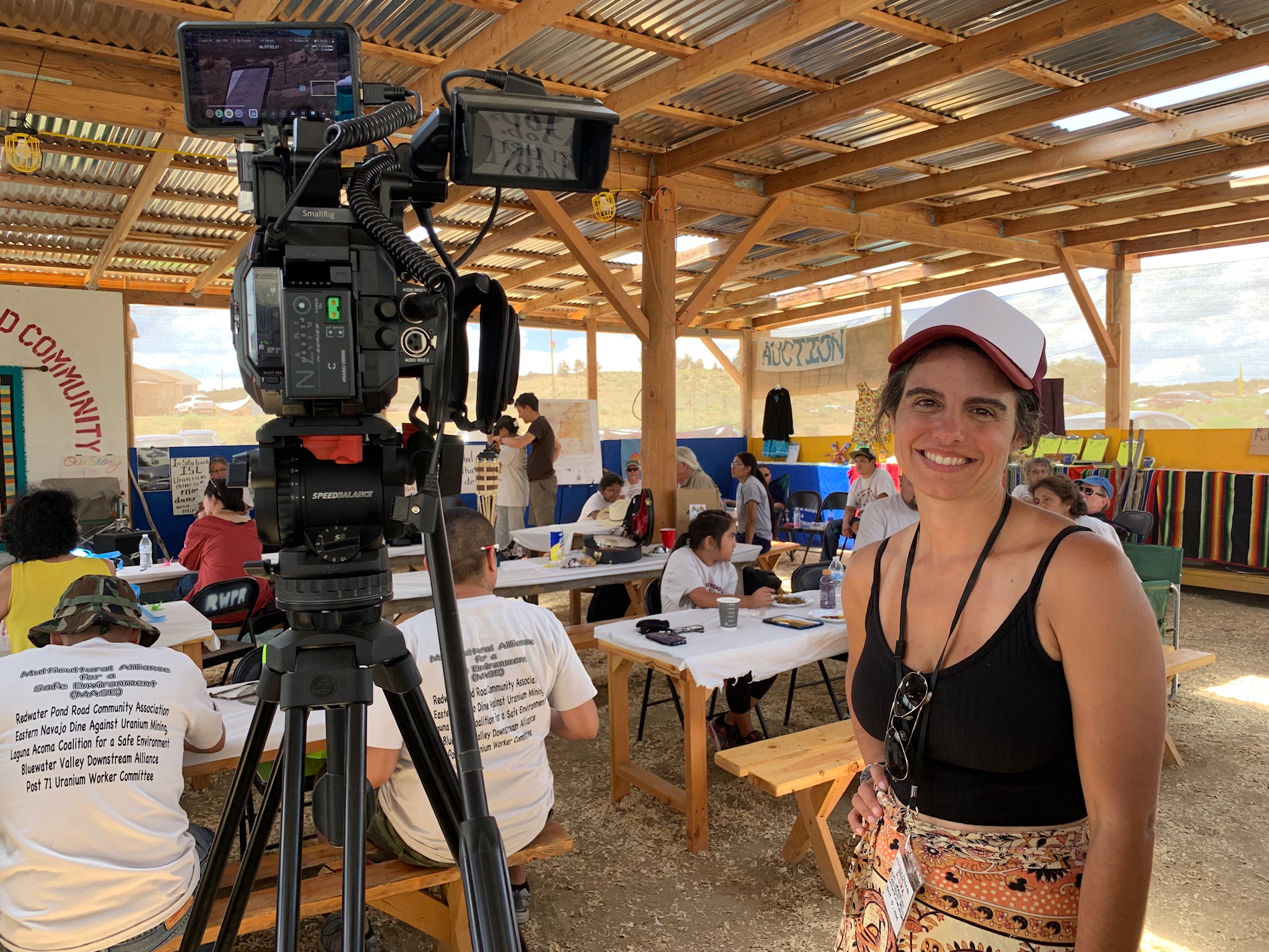
main image: Austin at a gathering for the 40th anniversary of the Church Rock mine spill on the Navajo Nation. Photo by Yoni Goldstein.