SHŌ and the Art of Play
We often think of creative practice as deeply serious and even emotionally and mentally taxing. But across disciplines, from visual art to culinary craft, the act of experimenting, improvising, and taking creative risks often shapes not just the work itself but the way creators engage with their chosen medium and their audience.
In a new series, we look beyond the final product and rewind a bit to understand how curiosity, spontaneity, and joy inform process, influence decisions, and open up unexpected pathways to innovation. First, we spoke with Chef Mari Katsumura about how she weaves play into her omakase practice.
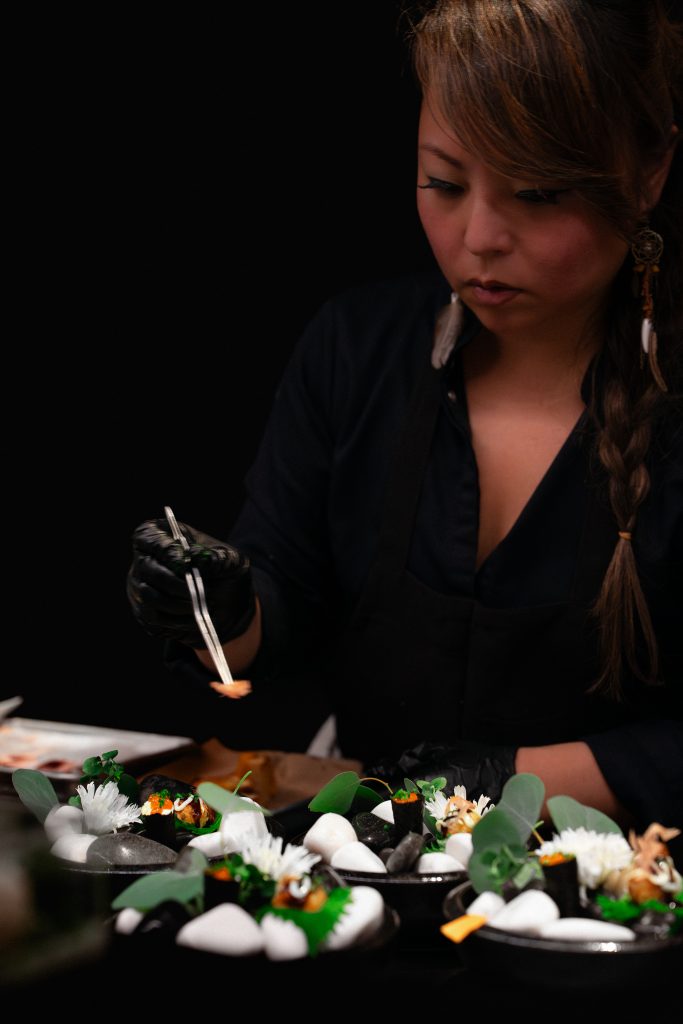
Located in the cultural heart of Chicago’s Old Town neighborhood, SHŌ presents more than a meal; they have created a thoughtfully realized world, where music, light, and space converge with food to create an experience that feels carefully chosen yet alive, structured yet unpredictable. At the helm is Chef Mari Katsumura, whose background in art history and studio arts informs a sensibility that treats every dish as both narrative and object.
For Katsumura, creativity is inseparable from play: experimentation, curiosity, and joy are essential ingredients in an omakase discipline that is traditionally framed by precision and tradition.
SHŌ’s omakase is rooted in Japanese culinary rigor, yet Katsumura and co-founder Adam Sindler have layered it with a sensibility that is distinctly (and delightfully) contemporary. The playlist that flows through the space is deliberate, subtly shifting each day to shape mood and pace. The dining experience is designed to engage the senses, allowing guests to inhabit a world that feels both intimate and expansive, playful and still intentional.
“Truly like a journey,” Katsumura says. “Adam has created this playlist that really speaks to the vibe, the energy of the space. It’s fun, upbeat, playful, but it also has a moodiness about it. The food mirrors the music: fun, thoughtful, mindful. Omakase can traditionally feel sterile. For us, it’s more of a modern expression.”
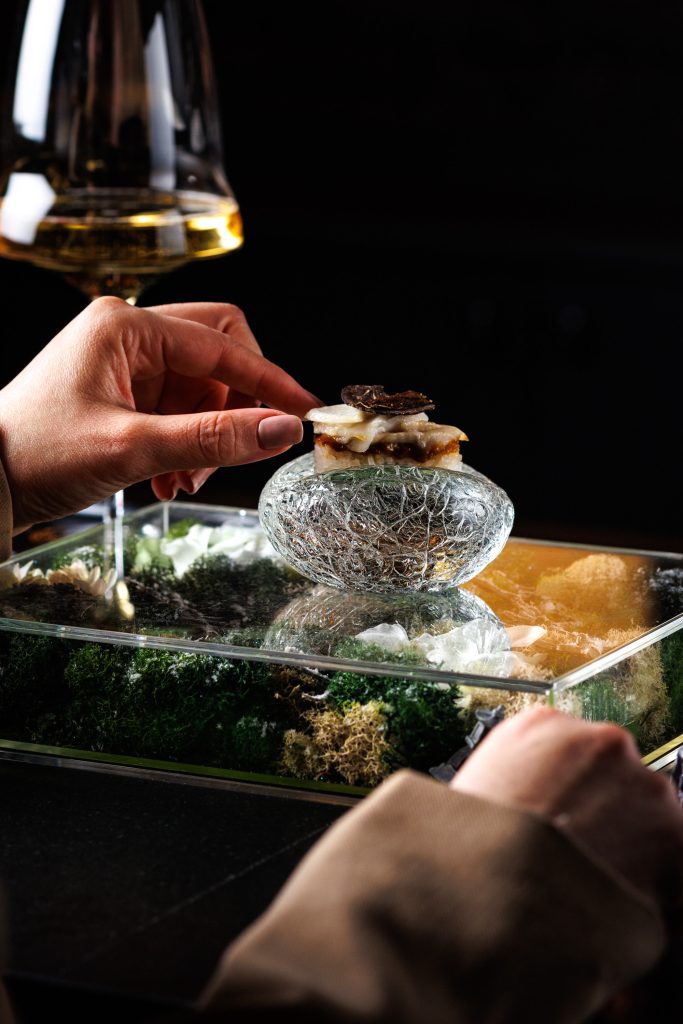
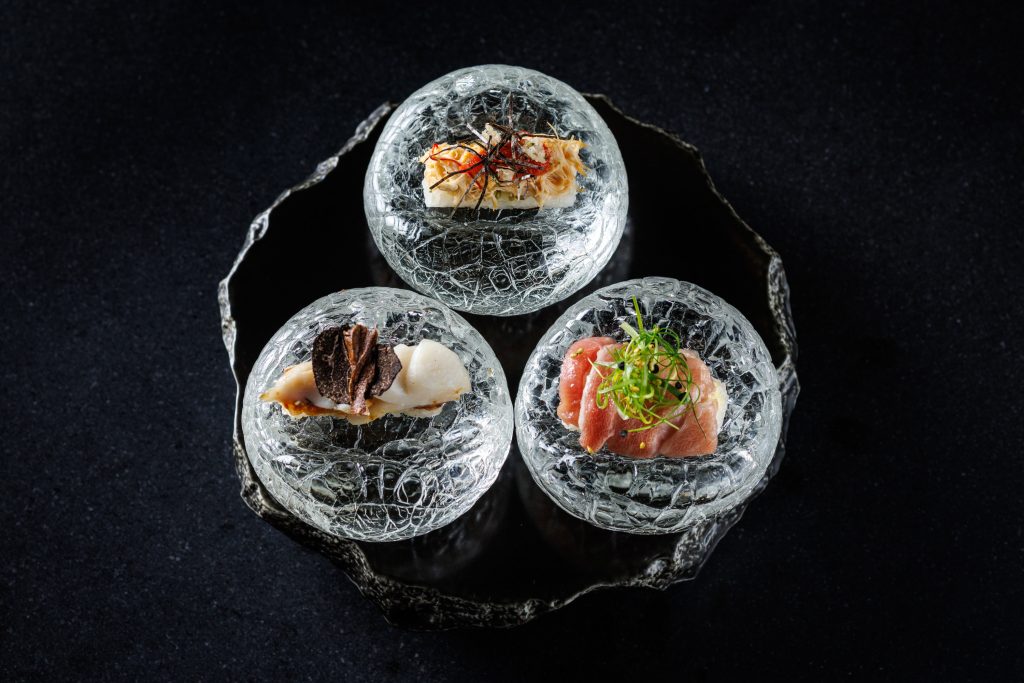
Play enters the kitchen through improvisation and responsiveness without undermining the necessary structure. Every slice of fish, every delicate plating decision, reflects focus and mastery. Yet Katsumura builds surprise into the experience. A dish like sukiyaki with Wagyu, cotton candy, and hand-rolled elements invites guests to be a part of the rhythm, making familiar flavors feel new and unexpected. “Each dish comes from a homey place. I try to create dishes that are approachable but complex underneath. Music, flavor, and hands-on interaction all work together,” she says.
The influence of sound on her creative process is central. “When I listen to music while plating, I can channel something beyond technique,” she explains. Sound activates more than taste; it shapes energy, tempo, and emotion, allowing the dishes to express layers that flavor alone cannot. Music becomes an invisible collaborator, guiding rhythm and mood, informing how Katsumura interacts with both ingredients and guests.
Katsumura’s culinary imagination is also an exciting exercise in cultural layering. Japanese, French, and Spanish techniques converge seamlessly, guided not by spectacle but by intuition. She points to her chawanmushi as an example: a traditional Japanese custard topped with a French-style espuma and Spanish-inspired accents. “It probably shouldn’t make sense on paper, but for me, it did. It’s just flavor 101,” she says. It’s an approach that mirrors the broader creative principle of play: blending disparate elements until they resonate as a coherent whole.
Beyond the technical and sensory innovations, Mari hopes guests leave SHŌ transformed. “If people can leave feeling joy, more alive, or at peace, then we’ve done our job,” she says. She is already imagining the next iteration of her menu, a vegan, temple-inspired concept that distills play into simplicity, honoring vegetables and seasonal ingredients with mindfulness and care.
At SHŌ, play is not frivolity. It is an essential form of creative intelligence, an intentional lens through which tradition meets experimentation, and discipline is reshaped into a canvas for pure delight. It is a reminder that in any artistic practice, whether in food, painting, or design, the act of exploring, improvising, and responding is where imagination thrives and catches fire.
images: Chef Mari Katsumura, courtesy of Alexa Giterman. All other images Courtesy of Mistey Nguyen.
Footnotes: Play as Method
Play is often mistaken for the absence of structure, when in practice it is a way of working through structure, and sometimes breaking it altogether. Across disciplines, artists have long relied on experimentation, repetition, and improvisation as methods of discovery. The compositions of John Cage, with their openness to chance, and the immersive environments of Yayoi Kusama, built through obsessive repetition, both suggest that play is not a departure from rigor but a necessary component. It allows a practice to remain alive, responsive, and in motion.
What distinguishes play in a serious creative practice is not spontaneity alone, but intention. It operates within constraints. A set of rules, materials, or traditions provides the framework, and within that framework, variation begins. Painters return to the same subject until it shifts. Musicians reinterpret a structure until it opens. Chefs revisit a dish until it reveals something new. Play, in this sense, becomes a form of testing. It asks what happens if this changes, if this moves, if this is pushed just slightly further?
There is also a temporal quality to play that is easy to overlook. It requires time, and often a willingness to move without immediate resolution, which can be frustrating. When speed and output are increasingly valued, play can appear inefficient. Yet it is precisely this slower, more exploratory mode that allows for depth. It creates space for intuition to surface, for unexpected connections to emerge, and for a practice to evolve beyond its initial logic.
To treat play as a method is to accept that not every gesture needs to resolve into a final answer. Some are simply part of a larger process of becoming. What results is work that feels less fixed and more alive, shaped not only by discipline and skill, but by curiosity and the willingness to remain open to what might happen next.