The (Not So) Quiet Politics of Contemporary Art
It surprises absolutely no one to learn that the art world is still largely shaped by scarcity, spectacle, and inherited privilege. Lofty Spot offers a different proposition: that access does not have to mean dilution, and that intimacy can be as powerful as scale.
Founded in London by Lauren Demir, the platform touches themes of education, collectorship, and cultural curiosity, inviting new audiences into contemporary art through carefully curated editions priced under £1,000.
The goal is not simply to sell work, but to dismantle the anxiety that often surrounds it, replacing intimidation with context, and exclusivity with connection.
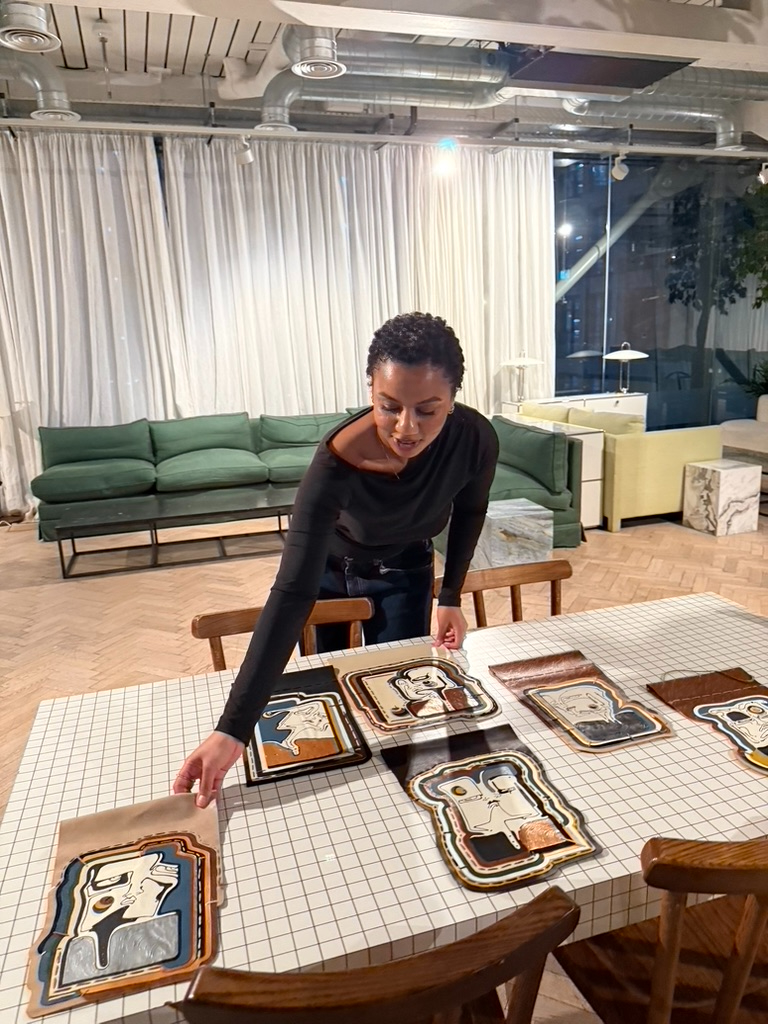
That ethos finds a natural counterpart in the work of Elfreda Dali, one of the artists featured in Lofty Spot’s Editions Series. Working primarily with reclaimed textiles and studio offcuts, Dali approaches material as memory, labor, and archive. Her practice resists the disposability embedded in both fashion and art, transforming fragments into meditations on migration, identity, and renewal.
Each piece carries the emotional residue of prior use, inviting viewers to consider not only what they see, but what has been held, worn, transported, and endured before arriving in its present form.
Together, Lofty Spot and Dali articulate a vision of contemporary art rooted not in spectacle or status, but in attention, trust, and care. Their shared commitment to slowness and intentionality challenges dominant models of visibility and value, asking what it might mean to build systems that honor both artistic rigor and emotional resonance.
Our current cultural moment is driven by speed, scale, and constant output; their work offers a deeply considered, more grounded counterpoint, one that centers lived experience, thoughtful exchange, and the long arc of creative growth.
In an extended Q&A, we speak with both Demir and Dali about access and authorship, the emotional and material labor behind contemporary art, the politics of visibility, and what it means to build slower, more intentional systems of exchange between artists, audiences, and the work itself. First up, Lauren Demir.
Lofty Spot sits at the intersection of access, education, and desire. What gap did you feel most urgently when you started this project, and which part of that problem still feels the hardest to solve?
One of the biggest gaps I noticed was how intimidating the art world can feel if you haven’t grown up around it. Art gets treated differently from other cultural forms. We’ll happily critique films or music, but with art, there’s often this hesitation, like you need the right language before you’re allowed an opinion.
I learned about art by going to exhibitions, spending time with work, noticing what I responded to and what I didn’t, and slowly trusting that. That’s where the confidence came from. Lofty Spot grew out of wanting to make that process feel possible for other people, too, without the pressure of feeling like they’re getting it wrong.
The hardest part is still helping first-time collectors trust the decision to live with art. Eight hundred pounds is a lot of money for something that’s going on your wall, and you don’t always know straight away what a piece will give back to you. That takes time. Because of that, I’m careful about how much I push. If someone decides to buy, it has to come from a real connection.

The art world often speaks the language of openness while operating through gatekeeping. What does “access” actually mean to you in practice, and where do you draw the line between accessibility and dilution?
For me, access is about feeling like you belong in a space without being judged. It’s about being able to ask questions, even obvious ones, without feeling stupid or out of place. I’m naturally curious, and I don’t think that should ever be something you grow out of.
Where it starts to go wrong is when accessibility gets confused with flattening everything. Access doesn’t mean pretending all art is doing the same thing or should be approached in the same way. Some work is highly intentional, built through research and long enquiry, and other work is more instinctive or decorative. That difference matters.
When we avoid talking honestly about what a piece of work is trying to do, or where it sits, just to avoid discomfort, we do people a disservice.
You’ve chosen to work with editions under £1,000– still a significant price point, but intentionally more reachable. How do you think price shapes not just who collects art, but also how people relate to it?
Price shapes everything. We all use it as a shortcut to decide whether something feels like it’s for us or not. So when people see certain prices in art, the instinctive response is often not for me yet, and that makes sense.
A thousand pounds is still a lot of money, but it sits in a middle space that feels important. Especially when people can pay in installments. It values the work properly in terms of material, scale, and labor, without making art feel like something only a very small group can access.
Price also changes how people relate to the work emotionally. Visual art is often framed as an investment, so people start thinking about return rather than response. At this level, people are more likely to buy because something genuinely speaks to them, not because they’re trying to make the safest or smartest decision.

Lofty Spot feels less like a marketplace and more like a point of entry. What do you hope first-time collectors understand about contemporary art after engaging with the platform?
I want people to realize that you don’t need to have studied the history of art or be able to name blue-chip artists to engage with contemporary art. Everyone has something that will speak to them, and that relationship changes over time.
There are artists whose work I didn’t connect with at first, but once I understood a bit more about where the work was coming from, something shifted. It didn’t mean I suddenly loved it, but it changed how I related to it.
What I hope Lofty Spot does is take some of the pressure away. I want people to feel comfortable asking questions they think might be silly, or saying they like a work simply because it’s blue and that’s their favorite color. That’s still a valid response.
The Editions Series introduces another layer to your work. Why was this the right moment to launch it, and what does collaboration mean to you in this context?
When I first had the idea for Lofty Spot, it was always about selling art. Over time, I ended up doing more brand work, including with UGG, and while that was useful, it made something clear to me. A lot of brands want to be close to culture, but they don’t always understand the pace and care that goes into an artist’s career.
When I stripped everything back, I kept coming back to selling work in a considered way. The Editions Series felt like the right moment because it brings the focus back to that original intention, but in a way that aligns with my values around access and care. Even with the economic climate being what it is, people still spend money on the things they care about. Art should be part of that. It should sit alongside holidays, clothes, or furniture as something you choose because it adds something to your life.
When you look at the current art ecosystem, what systems feel most outdated, and where do you see real possibilities for structural change?
A lot of the dominant systems in the art ecosystem still feel quite outdated. Large art fairs are a good example. The booth model prioritises speed and visibility over context and care, and that can be exhausting for both artists and audiences. The rise of alternative fairs and pop-ups suggests people are looking for slower, more considered ways of encountering work.
That tension is especially noticeable at fairs focused on Black art. Representation increases, but the structures around who sells, mediates, and validates the work don’t always change alongside it.
Where I see real potential for change is in more flexible, artist-led models. Traditional galleries often have fixed rosters, which makes it hard to respond to emerging artists. Smaller, more adaptable organizations are better placed to meet artists where they are. That shift feels necessary.

Looking ahead, what would success for Lofty Spot look like if you measured it not in sales, but in impact?
Although Lofty Spot is a business, I don’t really measure success by volume or visibility. For me, it’s about whether the work we support actually changes how people engage with contemporary art.
Using numbers as proof of success can shut down criticism or reflection, and in the arts, that can be damaging. It flattens how we value work and how we understand the labour behind it. Impact looks like working closely with artists whose work feels thoughtful and genuine, and presenting that work with care.
On the audience side, success is when people come away with a deeper connection to an artist’s process and intention. If Lofty Spot helps bridge that gap between making and understanding, that feels like meaningful impact to me.

Artist Elfreda Dali
You’re working with leftover materials from your studio. How does constraint shape your creativity, and what kinds of stories emerge when you work with what’s already been used?
I find that the shapes, colours, and patterns of offcuts become their own unique contribution to the overall story, pushing me to sometimes think outside the box. I don’t allow constraint to shape my creativity, but I do find the exercise of it to be quite rewarding.
When I work with what has already been used, it brings deeper context to the work, like the continuation of a pre-existing story. Everything from the physical journey of the material between continents to the emotional residue of whoever owned it. It brings unexpected aspects that contribute to the nuance and legacy of the work.
A resistance to our relationship with waste and disposability also plays a role here. Our culture of speed, novelty, and excess production negates the need to protect and preserve. For me, it is less about constraint or limitation and more about creating a flow for materials, memory, and the narratives embedded in them.
Breaking into the art market can feel opaque, even for artists showing internationally. What have been the most challenging parts of navigating visibility and access so far?
The total vulnerability of the inspiration behind my work and what exactly it represents for me was one of the earliest challenges. I pushed past that fairly quickly after the conscious decision to maintain the work’s integrity. Navigating narratives that are imposed on me or the work is another one.
Beyond that, I think being a woman of color in a space like this comes with its own set of uniquely evolving challenges. To me, they are all signs of progress, so I don’t focus on them too much.
That said, visibility is never neutral, and the politics around you move narratives that control the systems. Learning how to thrive alongside these structures and not dilute the truth of the work is an ongoing process.
What does it mean to you to have your work offered through an editions model, especially one aimed at newer collectors?
I think the work of an artist beyond the studio is to curate the appropriate channels and systems for your work to thrive. This is a physical manifestation of that for me. I am very proud of what we have accomplished.
Many artists are now asked to be both maker and marketer. How do you protect the integrity of your practice while navigating those expectations?
Knowing when to say no goes a long way. I think it begins with having a deep understanding of who you are and what that means for your work by extension. Alongside that, a clear vision for your practice will always be a guideline for where to go and what to do. You don’t have to grace every stage because you got an invite.
What would make the art world easier to enter without making the work itself easier or less rigorous?
I think more support on the business of being an artist that provides access to pathways outside the gallery representation model would have a great impact.
Beyond that, I think the art world is accessible on all levels if you have a unique point of view. A unique perspective goes beyond style, taste, and skill level; it must be grounded in your personal truth. The ability to articulate something feels synonymous with our shared humanity. Mastering what this looks like for your contribution tends to open unstructured channels to growth. A system that tends to thrive in this space.

If someone encounters your work for the first time through Second Spring, what do you hope they feel, or reconsider, about textiles, labor, and value?
The inspiration behind Second Spring is the ushering in of a new season. It celebrates the pain of shedding and the joy of sprouting seeds. The use of sustainable materials carries this theme, honouring transformation beyond perfection. I hope it inspires them to embrace their own cycles of becoming free of judgment.
Also, I hope it prompts a reconsideration of the value assigned to textiles and labor.
Bringing these materials into the context of contemporary art challenges the hierarchy and highlights the intellectual, emotional, and political weight embedded in fabric. Something we feel and respond to subconsciously in our everyday lives. I want it to be a quiet yet convincing challenge and inspiration.
Learn more about Lofty Spot here, and explore more of Elfreda Dali’s work here.