Who Gets to Be An Art Collector?
The traditional art fair asks you to know a surprising amount before you even walk through the door. You are expected to know which galleries matter, which artists to look for, how the buying process works, what questions to ask, what things cost, and, perhaps most importantly, whether you even belong there at all.
SPLIT LEVEL was created to offer a different kind of art fair experience. Founded by artist and gallerist Jaqueline Cedar, the fair brings together young galleries, independent dealers, and project spaces focused largely on emerging artists. Its first edition grew out of Cedar’s experience with Good Naked, the gallery she began in her Brooklyn apartment before developing a nomadic practice through exhibitions, performances, and collaborations.
SPLIT LEVEL carries that spirit into a fair format, presenting art in Rimadesio’s design-focused environment rather than a conventional grid of identical booths. Its programming extends beyond the exhibitions themselves, with performances, talks, and guided tours designed to encourage visitors to spend time with artists, gallerists, and the work. The fair’s host committee includes collectors, advisors, curators, and art-world professionals, among them Casey Monda, Nicholas Sorensen, and Neha Jambhekar.
That makes its attention to collectorship feel especially intentional. Because for all the talk about making contemporary art more accessible, the act of actually buying it can remain remarkably intimidating. There is the obvious question of money, but price is only part of it. There is also the vocabulary, the etiquette, the fear of asking the wrong question, and the nagging suspicion that everyone else in the room understands something you don’t.
Casey Monda, art advisor and founder of Art I Saw & Liked and a member of SPLIT LEVEL’s host committee, has spent much of her career thinking about how to make collecting less mysterious. “The term art collector carries a lot of baggage,” she says. Some of that baggage comes from the spectacular stories that surround the art market: record-breaking auctions, famous collections, impossibly expensive works. Some comes from the way art is presented online, where even relatively affordable contemporary work often appears in immaculate homes that seem to suggest a particular kind of wealth, taste, and cultural fluency.
The result is that people can mistake collecting for a status they either possess or don’t. Monda sees the problem differently. “I actually prefer the term art buyer,” she says. “It doesn’t require you to have earned anything — it just means you want art in your life.” That could mean one important work in a home, a piece discovered on a trip, something purchased from a young artist, or eventually a collection built over decades. There is no required starting point.
The more difficult barrier, however, may have less to do with whether someone can afford a work than whether they trust themselves to choose one. “What actually stops people is the fear of being wrong, of choosing something and having someone more knowledgeable see it and think less of them for it,” Monda says. Collecting asks you to make a declaration of taste. You have to say, in effect, I like this enough to live with it. Expertise is increasingly presented as something that can be performed online, and that vulnerability can feel uniquely high-stakes.
This is where the art world’s historic gatekeeping becomes important. Collecting has long been built around networks of access: private relationships with dealers, early invitations, VIP previews, advisors, insider vocabulary, and information that isn’t always available to everyone equally. Even the physical spaces can reinforce the divide. A first-time visitor walking into a gallery may encounter work without prices, unfamiliar names, specialized language, and the assumption that they already understand how the room works.
The industry has benefited from that exclusivity, of course, but it has also created a strange problem for itself. Contemporary art needs people to buy it. Artists need collectors. Galleries need sales. Yet the pathway to becoming the person who makes that first purchase can feel deliberately obscure.
Neha Jambhekar knows both sides of that equation. As a collector and art-world professional, she came into collecting through proximity to the infrastructure itself. Early in her career, she spent eight years at artnet, including working with its Gallery Network, where she developed relationships with galleries and became deeply familiar with the programs being presented across New York. She now works in gallery and project management at Art Basel and has also worked as a curator and collaborator through Jambhekar/Cruz, a platform she founded with Cristina Cruz to create opportunities for emerging artists from underrepresented backgrounds.
For Jambhekar, that familiarity made collecting feel natural. She began acquiring small works from artist friends and has built much of her collection by following artists’ studio sales on Instagram. “Having the knowledge of art pricing and personal relationships with artists makes collecting really accessible to me,” she says.
There is something revealing in that admission. Access is often less about a secret code than about accumulated proximity: knowing an artist, knowing a gallery, knowing where to look, knowing that a studio sale is happening, knowing what a reasonable price might be. Those are forms of knowledge that can seem invisible to someone encountering the art world from the outside. What feels effortless to an insider can feel like a closed door to everyone else.
Jambhekar has tried to turn that knowledge outward. She routinely shares price lists with family and friends outside New York, adding context about the artists and their work. She can point to three people, including her sister in Orlando, who have begun collecting art this way. “But mainly, if you can create personal touch points for someone that has never bought artwork before, it goes a long way in converting them into a collector.”
That idea of the personal touch point is at the heart of what SPLIT LEVEL’s collectorship programming can offer. Rather than treating the fair as simply a place to see and sell work, its talks and tours create opportunities to ask questions and develop a relationship with the work before making a decision. The fair’s broader model already emphasizes shared audiences, conversation, and alternative ways of presenting art. Extending that thinking to new collectors means recognizing that accessibility isn’t only about making something affordable. It is also about making the experience legible.
For Nicholas Sorensen, a collector, advisor, and member of the fair’s host committee, the first step toward buying art can be surprisingly uncomplicated. “I think either seeing something familiar in a piece and having a connection with the artist, gallery, or the process by which a piece is made can all be great ways to confidently buy a first artwork.” Sometimes, he says, the catalyst is even more practical: needing something for a space.
That may be one of the most useful ways to think about becoming a collector. Your first purchase doesn’t need to announce the arrival of a fully formed, sophisticated collection. It can simply be something you want to look at every day.
Nor does making the experience personal mean pretending the commercial side doesn’t exist. “Developing a relationship will personalize and soften the experience if time allows for it, but let’s not forget that selling artworks is how artists and galleries make money,” Sorensen says. The healthiest collecting experience can hold both things at once: the emotional reason someone wants a work and the very real business that makes it possible for artists and galleries to continue.
Monda is also skeptical of the idea that the solution is simply to make traditional fairs friendlier. The problem, she argues, is structural. VIP access, early buying, concentrated markets, overwhelming presentation, and the sheer volume of art can make fairs difficult places for newcomers to develop a point of view. Her answer is partly decentralization: bringing serious art and the people who know it into more places, and creating smaller contexts where people can actually look.
“What if it went the other way?” she asks, imagining established fairs using their infrastructure and relationships to create smaller programs in cities outside the usual art-market circuit. “Great doesn’t have to mean expensive, and it doesn’t have to mean New York.”
That question gets at something larger than one fair’s programming. If the art world wants a new generation of collectors, it has to make room for people to become collectors on their own terms. They may not have grown up around art. They may not know the difference between a primary and secondary market. They may have a perfectly ordinary apartment, a full-time job, and absolutely no interest in turning their living room into a showroom. They may simply have seen something that stopped them. That should be enough to start.
There is also a useful lesson in Jambhekar’s experience: accessibility doesn’t necessarily require removing expertise from the equation. It can mean sharing it. A price list with a little context. An introduction to an artist. A conversation that makes it easier to ask the next question. A fair where someone can linger long enough to develop an opinion before feeling pressured to have one.
SPLIT LEVEL’s collectorship programming is valuable because it treats the first purchase not as the final step in acquiring expertise, but as part of the process of developing it. You look. You ask. You learn. You find something that stays with you. Eventually, perhaps, you buy it.
And somewhere along the way, you may realize that you didn’t need permission to call yourself a collector in the first place.
SPLIT LEVEL runs October 1–3 in New York.
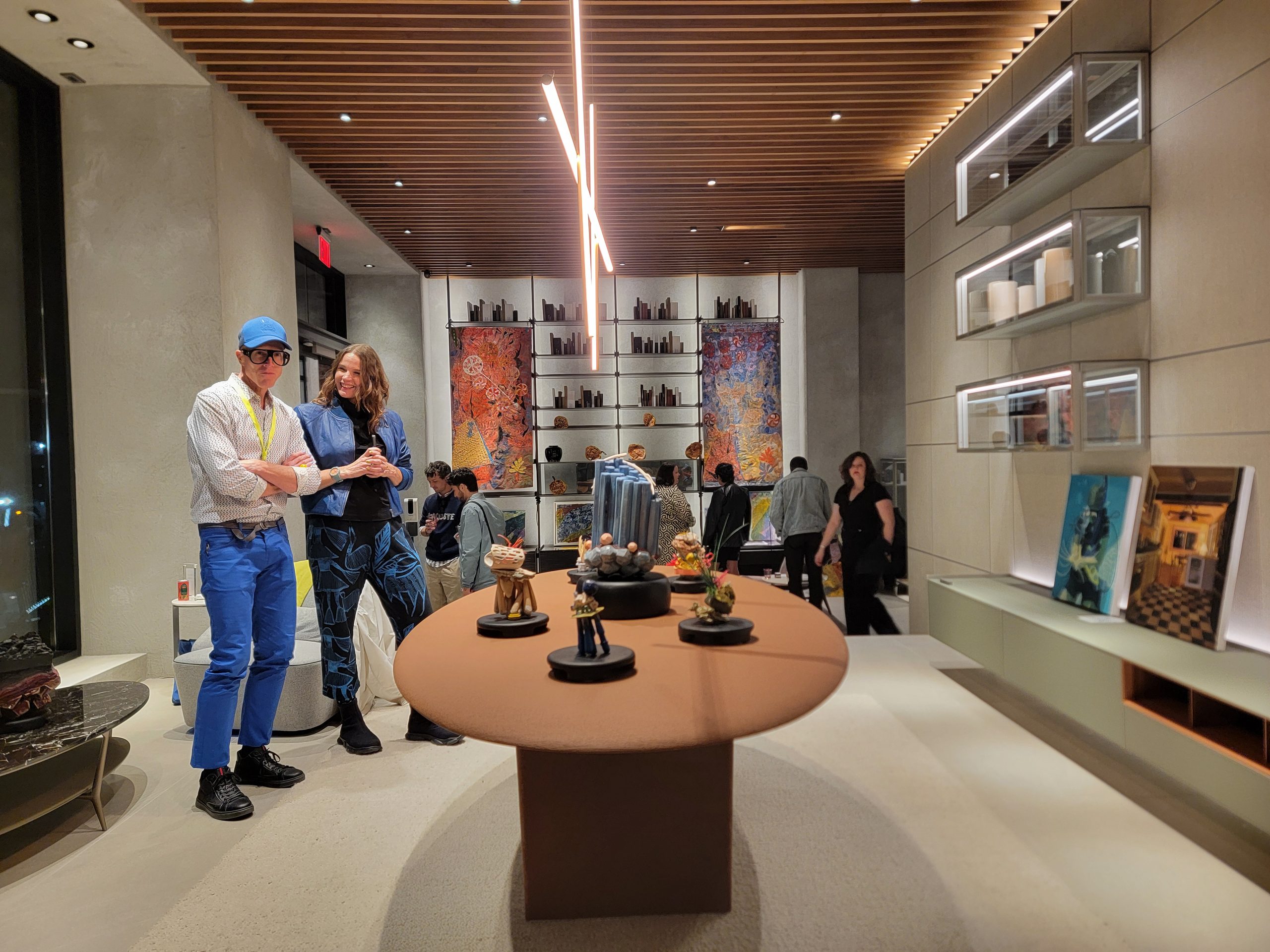
image: install at SPLIT LEVEL, 2025.